UAE Personal Data Protection Law (PDPL): What Businesses Must Do Now
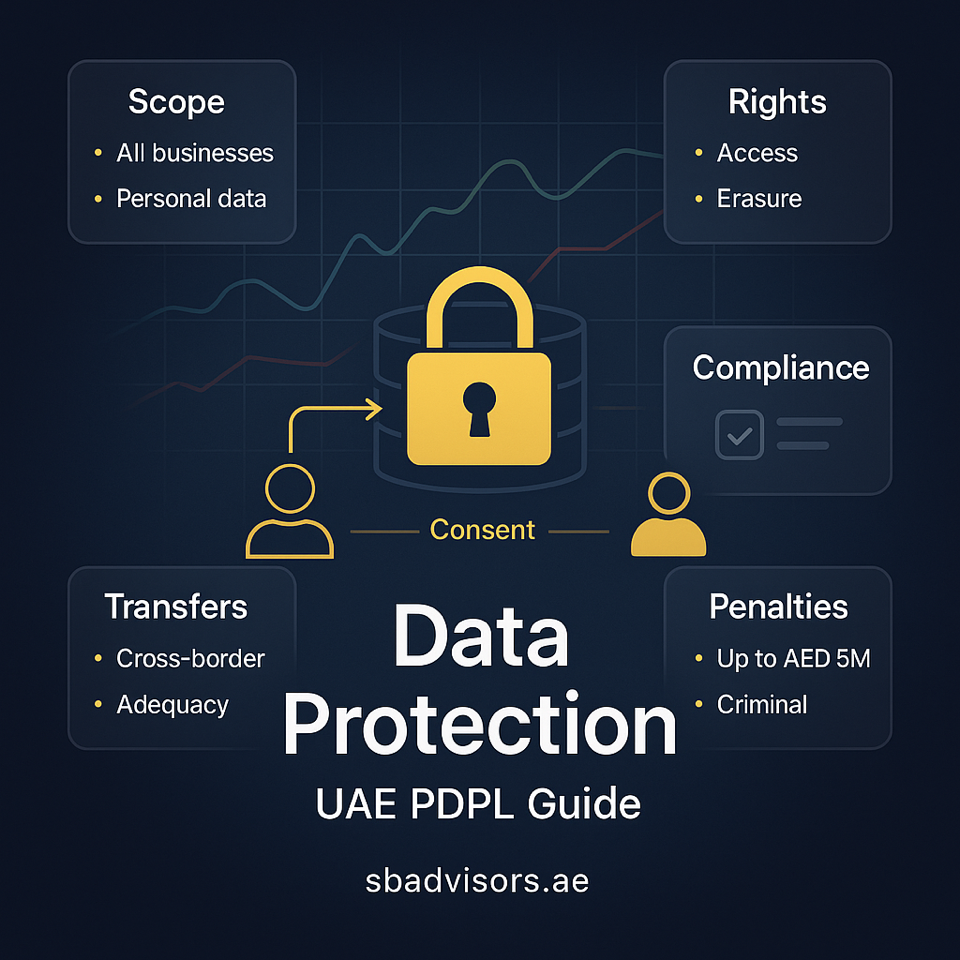
The UAE’s Personal Data Protection Law (Federal Decree-Law No. 45 of 2021, commonly called the PDPL) is in force. Most UAE businesses collect personal data: customer details, employee records, payment information, website analytics. If you do any of that, the PDPL applies to you.
The law is broadly modelled on the EU’s GDPR but with UAE-specific features. The penalty framework is real, and enforcement is ramping up. The time to get compliant was yesterday.
Quick answers
- What is the PDPL? The UAE’s federal data protection law governing how businesses collect, process, store, and transfer personal data.
- Who does it apply to? Any entity that processes personal data of individuals in the UAE, whether the entity is based in the UAE or abroad.
- Does it apply to employee data? Yes. Employee records (personal details, salary, health information, visa copies) are personal data under the PDPL.
- What are the penalties? Administrative fines up to AED 5 million. Criminal penalties including imprisonment are possible for serious violations.
- Do I need a Data Protection Officer? Required for entities processing sensitive personal data on a large scale, entities conducting regular and systematic monitoring of data subjects, and public entities.
- How does it compare to GDPR? Similar in structure and principles. Key differences include the consent framework, cross-border transfer rules, and enforcement mechanisms.
Who Must Comply?
The PDPL applies to:
- UAE-based businesses that process personal data, regardless of whether the data subjects are in the UAE or abroad.
- Foreign businesses that process personal data of individuals located in the UAE (e.g., an overseas e-commerce business selling to UAE customers and collecting their data).
- Government entities (with some exemptions for national security, law enforcement, and judicial functions).
Exemptions:
- Personal data processed for purely personal or family purposes.
- Data processed by healthcare entities to the extent covered by health data regulations.
- Data processed by financial entities in DIFC and ADGM, which have their own data protection frameworks (DIFC Data Protection Law 2020 and ADGM Data Protection Regulations 2021).
- Government data processing for security or defence purposes.
Core Principles
The PDPL establishes principles that mirror international standards:
- Lawfulness, fairness, and transparency: Data must be processed lawfully and the data subject must be informed.
- Purpose limitation: Data must be collected for a specific, clear, and legitimate purpose.
- Data minimisation: Only collect what you need. Do not stockpile data “just in case.”
- Accuracy: Keep data accurate and up to date.
- Storage limitation: Do not retain data longer than necessary for the stated purpose.
- Integrity and confidentiality: Implement appropriate security measures to protect data.
Legal Bases for Processing
You need a valid legal basis to process personal data. The PDPL provides several:
- Consent: The data subject has given clear, explicit consent for a specific purpose. Consent must be freely given, informed, and withdrawable.
- Contract performance: Processing is necessary to fulfil a contract with the data subject (e.g., processing a customer’s address to deliver their order).
- Legal obligation: Processing is required by UAE law (e.g., maintaining employee records under labour law, AML/KYC checks, tax reporting).
- Vital interests: Processing is necessary to protect someone’s life.
- Public interest: Processing is in the public interest or for the exercise of official authority.
- Legitimate interests: Processing is necessary for the controller’s legitimate interests, provided those interests are not overridden by the data subject’s rights.
Consent requirements:
- Must be given before processing begins.
- Must be for a specific, defined purpose (blanket consents are invalid).
- Must be freely given (not a condition of providing a service unless the data is necessary for that service).
- Data subjects must be able to withdraw consent as easily as they gave it.
- Consent for processing sensitive data (health, biometric, genetic, religious beliefs, criminal records) must be explicit and specific.
Data Subject Rights
Individuals have the following rights under the PDPL:
- Right to be informed: Know what data is being collected, why, and how it will be used.
- Right of access: Request a copy of their personal data held by you.
- Right to rectification: Request correction of inaccurate data.
- Right to erasure: Request deletion of their data when it is no longer needed or consent is withdrawn (subject to legal retention requirements).
- Right to restrict processing: Request that processing be limited in certain circumstances.
- Right to data portability: Receive their data in a structured, machine-readable format.
- Right to object: Object to processing based on legitimate interests or for direct marketing.
You must respond to data subject requests within 20 business days of receiving a valid request.
Cross-Border Data Transfers
The PDPL restricts the transfer of personal data outside the UAE unless:
- The receiving country or territory provides an adequate level of data protection as determined by the UAE Data Office.
- Appropriate safeguards are in place (binding corporate rules, standard contractual clauses, or other approved mechanisms).
- The data subject has given explicit consent to the transfer after being informed of the risks.
- The transfer is necessary for contract performance, legal proceedings, vital interests, or public interest.
This is particularly relevant for:
- UAE businesses using cloud services hosted outside the UAE (AWS, Azure, Google Cloud).
- Multinational groups sharing employee or customer data between UAE and overseas entities.
- Outsourced accounting or payroll providers based outside the UAE.
Data Protection Officer (DPO)
You must appoint a DPO if your business:
- Processes sensitive personal data on a large scale.
- Conducts regular and systematic monitoring of data subjects on a large scale (e.g., behavioural tracking, location monitoring, profiling).
- Is a public entity.
The DPO must:
- Have expertise in data protection law and practices.
- Report directly to senior management.
- Not hold a position that creates a conflict of interest.
Even if a DPO is not legally required, designating someone as the data protection lead is good practice for any business handling meaningful volumes of personal data.
Data Breach Notification
If a personal data breach occurs that poses a risk to the rights and freedoms of data subjects, you must:
- Notify the UAE Data Office without undue delay (specific timeframes will be set by implementing regulations).
- Notify affected data subjects if the breach is likely to result in high risk to their rights and freedoms.
The notification must include:
- The nature of the breach.
- The categories and approximate number of data subjects affected.
- The likely consequences.
- The measures taken to address the breach.
This is why cyber insurance matters. A data breach can trigger notification costs, legal fees, regulatory fines, and reputational damage simultaneously.
Practical Compliance Steps
1. Data inventory
Map what personal data you collect, where it is stored, who has access, and why you process it. You cannot comply with a law about data you do not know you have.
2. Privacy notices
Update your website privacy policy, employee privacy notice, and customer-facing terms to comply with the PDPL’s transparency requirements. State clearly what data you collect, why, how long you keep it, and who you share it with.
3. Consent mechanisms
Review how you obtain consent. Pre-ticked boxes, bundled consents, and consent buried in terms and conditions are not valid under the PDPL. Implement clear, granular, opt-in consent for each processing purpose.
4. Data processing agreements
If you share personal data with third-party processors (accountants, IT providers, cloud platforms, marketing agencies), you must have written agreements that require the processor to comply with the PDPL.
5. Security measures
Implement technical and organisational measures appropriate to the risk:
- Encryption of personal data in transit and at rest.
- Access controls (role-based, principle of least privilege).
- Regular security assessments.
- Employee training on data handling.
- Incident response plan.
6. Retention policy
Define how long you keep different categories of personal data. Align with legal requirements (e.g., 7 years for tax records, 5 years for AML records) and delete data that is no longer needed.
7. Data subject request process
Establish a process to receive, verify, and respond to data subject requests within 20 business days.
PDPL vs. DIFC and ADGM Data Protection Laws
| Feature | PDPL (Federal) | DIFC DP Law 2020 | ADGM DP Regs 2021 |
|---|---|---|---|
| Scope | All UAE (excl. DIFC/ADGM) | DIFC-registered entities | ADGM-registered entities |
| Model | GDPR-influenced | GDPR-aligned | GDPR-aligned |
| Regulator | UAE Data Office | Commissioner of Data Protection | Office of Data Protection |
| Transfer rules | Adequacy or safeguards | Adequacy or safeguards | Adequacy or safeguards |
| Breach notification | Yes (timeframe TBD) | 72 hours | 72 hours |
| DPO requirement | Conditional | Conditional | Conditional |
If your business operates in DIFC or ADGM, you follow their respective data protection laws, not the PDPL. If you operate in both mainland and a financial centre, you may need to comply with multiple frameworks.
Penalties
The PDPL provides for:
- Administrative fines up to AED 5,000,000 per violation.
- Criminal penalties including imprisonment for serious offences such as unlawful processing, data theft, or failure to comply with lawful orders from the UAE Data Office.
The UAE Data Office is the regulatory authority responsible for enforcement. While enforcement is still in its early stages, the legal framework is in place and businesses should not assume a grace period.
Frequently Asked Questions
Does the PDPL apply to B2B data? The PDPL protects personal data of natural persons. Business contact information (name, job title, work email of an individual at a company) is personal data. Purely corporate data (company financials, trade data) is not.
Do I need consent for every email I send? For marketing emails, yes. You need opt-in consent for direct marketing communications. For transactional emails (order confirmations, invoices), consent is not required because processing is based on contract performance.
How does the PDPL affect employee data? Employee data (personal details, salary, health records, visa copies) is personal data. Processing is lawful under legal obligation (UAE Labour Law) and contract performance, but you must still inform employees about how their data is used and maintain security.
Can I store data on cloud servers outside the UAE? Yes, provided the cross-border transfer requirements are met. This typically requires the data subject’s explicit consent, standard contractual clauses with the cloud provider, or confirmation that the receiving jurisdiction has adequate protection.
What is the difference between a controller and a processor? A controller decides why and how personal data is processed (your business). A processor processes data on behalf of the controller (your cloud provider, outsourced accountant). Both have obligations under the PDPL.
Do I need to register with the UAE Data Office? The implementing regulations may introduce registration requirements. Check the UAE Data Office website for the latest guidance.
How does data protection compliance affect my Corporate Tax position? The costs of PDPL compliance (DPO salary, legal advice, security software, training) are deductible business expenses for Corporate Tax. Fines imposed by the Data Office are not deductible.
How Success Business Advisors can help
We conduct data protection gap assessments, draft privacy notices and data processing agreements, and coordinate with specialist IT and legal advisors to build a proportionate PDPL compliance programme. Book a consultation and we will scope your data protection obligations in 30 minutes.
Ready to take the next step?
Schedule an Appointment WHO WE WORK WITH