Trademark and Intellectual Property Registration in the UAE: A Practical Guide
You spent years building a brand, developing a product, or creating original content. In the UAE, none of that is protected unless you take active steps to register and enforce your intellectual property rights.
The UAE has a modern IP framework, but it does not work like automatic protection systems in some other jurisdictions. Registration is the foundation. Without it, enforcement is difficult and expensive.
Quick answers
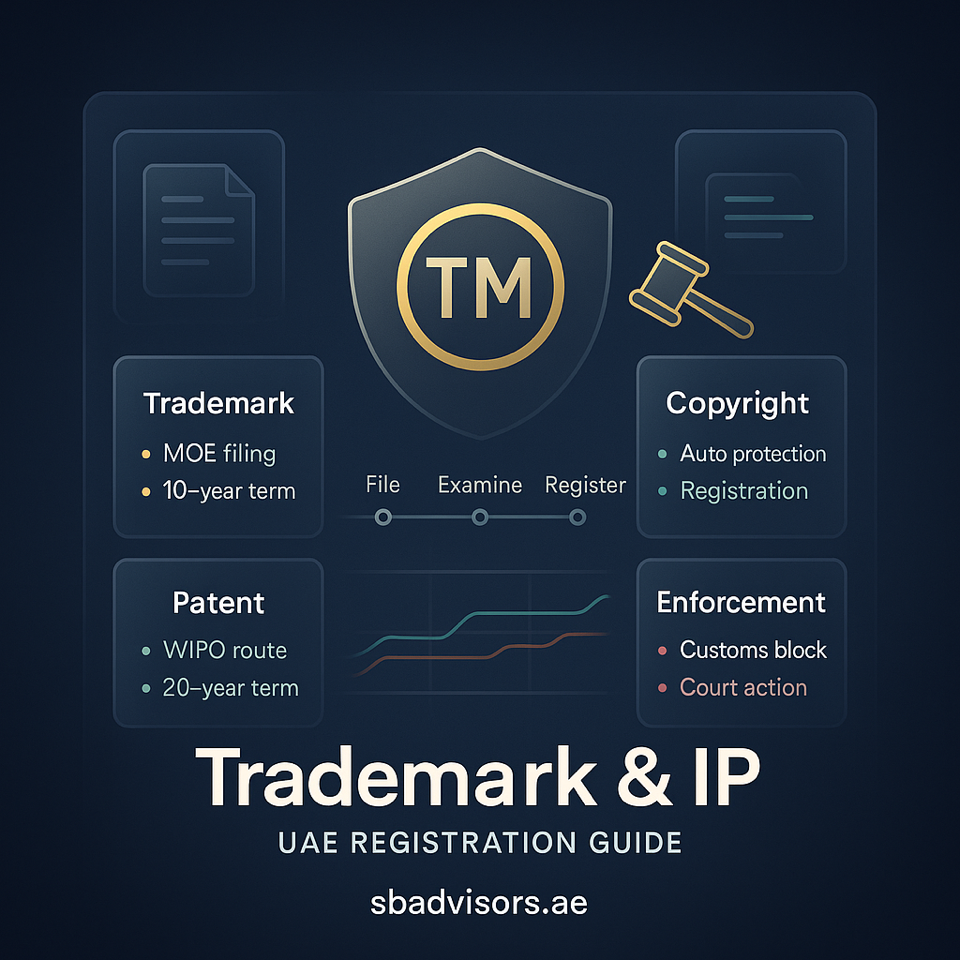
- How do I register a trademark in the UAE? File an application with the Ministry of Economy (MOE) through their online portal. The process takes 6 to 12 months.
- How long does a UAE trademark last? 10 years from the filing date, renewable for additional 10-year periods.
- Does a UAE trademark cover all GCC countries? No. UAE registration covers the UAE only. For GCC-wide protection, you need separate filings in each country or use the Madrid Protocol for international registration.
- Are patents available in the UAE? Yes. Patents can be filed through the MOE or via the GCC Patent Office. Protection lasts 20 years.
- Is copyright automatically protected? Copyright exists upon creation under UAE law, but registration provides stronger evidence in disputes. The MOE offers copyright registration.
- Can IP be an asset for Corporate Tax purposes? Yes. Acquired IP is recorded as an intangible asset and amortised. The cost of IP registration and protection is a deductible expense.
Trademarks
What can be trademarked?
A trademark is any sign that distinguishes your goods or services from others. In the UAE, this includes:
- Words, names, and slogans.
- Logos and graphic designs.
- Colours and colour combinations (in specific contexts).
- Three-dimensional shapes (product packaging, bottle shapes).
- Sound marks (limited acceptance, evolving practice).
The mark must be distinctive (not generic or descriptive of the goods/services) and must not be identical or confusingly similar to an existing registered mark in the same class.
The Nice Classification system
Trademarks are registered by product/service class under the Nice Classification system (45 classes). You must file in each class where you want protection. A restaurant might register in Class 43 (food services) and Class 35 (advertising/franchising). Each class is a separate filing with a separate fee.
Registration process
- Search: Conduct a trademark search through the MOE database to check if identical or similar marks exist in your class. This is not mandatory but strongly recommended.
- File the application: Submit through the MOE’s online trademark portal. Include:
- The mark (word, logo, or both).
- The class(es) of goods/services.
- Applicant details (company or individual).
- Power of attorney (if filed through a trademark agent).
- Filing fee: approximately AED 6,000-10,000 per class (including publication fees).
- Examination: The MOE examines the application for compliance with formalities and distinctiveness. This takes 2 to 4 months.
- Publication: If accepted, the mark is published in the Trademarks Journal for 30 days. Third parties can file oppositions during this period.
- Registration certificate: If no opposition (or if opposition is resolved in your favour), the registration certificate is issued.
Total timeline: 6 to 12 months from filing to registration, assuming no opposition.
Renewal
Trademarks must be renewed every 10 years. The renewal application should be filed in the 12 months before expiry. A 6-month grace period is available with a late fee. Failing to renew means losing the registration.
International registration (Madrid Protocol)
The UAE is a member of the Madrid Protocol, which allows you to file a single international trademark application through WIPO (World Intellectual Property Organisation) designating multiple countries. This is more efficient and cost-effective than filing separately in each country if you need protection in several jurisdictions.
Patents
What can be patented?
An invention can be patented in the UAE if it is:
- Novel: Not previously disclosed anywhere in the world.
- Inventive: Not obvious to a person skilled in the field.
- Industrially applicable: Capable of being used in some form of industry.
Software, business methods, and scientific discoveries are generally not patentable in the UAE (consistent with most civil law jurisdictions).
Filing routes
- UAE MOE: File directly with the Ministry of Economy for UAE-only protection.
- GCC Patent Office: File with the GCC Patent Office (based in Riyadh) for protection across all GCC member states.
- PCT (Patent Cooperation Treaty): File an international application through WIPO designating the UAE and/or GCC states.
Protection period: 20 years from the filing date, subject to annual maintenance fees.
Cost
Patent costs are significantly higher than trademarks. Including agent fees, filing fees, examination fees, and translation (the application must be in Arabic), expect AED 20,000-50,000 for a straightforward UAE patent filing.
Copyright
Automatic protection
Copyright exists automatically upon creation of an original work under UAE Federal Law No. 7 of 2002 (as amended). This covers:
- Literary works (books, articles, software code).
- Artistic works (photographs, illustrations, graphic design).
- Musical works and sound recordings.
- Audiovisual works (films, videos).
- Architectural designs.
You do not need to register copyright for it to exist. However, registration provides a public record and stronger evidence in enforcement proceedings.
Registration
The MOE offers copyright registration. The process is simpler and faster than trademark registration. You submit the work, a description, and a declaration of authorship. Fees are modest (AED 1,000-3,000).
Duration
Copyright protection lasts for the life of the author plus 50 years for most works. For works owned by legal entities, protection lasts 50 years from first publication.
Trade Secrets
The UAE Commercial Transactions Law and the Penal Code provide protection for trade secrets (confidential business information that derives value from its secrecy). There is no registration system for trade secrets.
Protection relies on:
- Contractual measures: Non-disclosure agreements (NDAs) with employees, contractors, and business partners.
- Internal controls: Restricted access, password protection, and classification of confidential information.
- Employment agreements: Non-compete and confidentiality clauses in employment contracts (enforceable in the UAE, subject to reasonableness).
If a trade secret is misappropriated, remedies include damages, injunctions, and potentially criminal prosecution under the Penal Code.
IP in DIFC and ADGM
Both DIFC and ADGM have their own IP-related regulations:
- DIFC: The DIFC Intellectual Property Law (DIFC Law No. 4 of 2019) provides a framework for IP rights within the DIFC. It recognises UAE-registered trademarks and patents and provides DIFC-specific remedies for infringement.
- ADGM: Follows UAE federal IP law but with common-law style enforcement through the ADGM Courts, which may be preferred for complex IP disputes.
For businesses registered in these jurisdictions, IP disputes can be heard in their respective courts, which apply common-law principles and are often faster than UAE federal courts.
Enforcement
Customs recordal
You can record your registered trademarks with UAE Customs. This empowers customs officers to seize counterfeit goods at ports of entry. This is a powerful tool for brand owners and is relatively inexpensive to implement.
Civil enforcement
File a civil claim in the UAE courts for trademark infringement, patent infringement, or copyright violation. Remedies include:
- Injunctions to stop the infringing activity.
- Damages (actual loss plus lost profits).
- Seizure and destruction of infringing goods.
- Publication of the judgment (at the infringer’s expense).
Criminal enforcement
Serious IP infringement (counterfeiting, piracy) can be prosecuted as a criminal offence under UAE law. Penalties include fines and imprisonment. Criminal complaints are filed with the Economic Department or the Public Prosecution.
IP and UAE Corporate Tax
IP assets interact with Corporate Tax in several ways:
- Acquired IP (trademarks, patents, licences): Recorded as intangible assets on the balance sheet and amortised over their useful life. The amortisation is a deductible expense.
- Internally developed IP: Costs of developing IP internally (R&D costs) may be capitalised or expensed depending on the stage of development and accounting treatment under IFRS.
- IP registration and legal fees: The costs of filing trademarks, patents, and defending IP rights are deductible business expenses.
- Royalty income: If you licence your IP to others, the royalty income is taxable. If the licensee is in a DTA country, the treaty may reduce withholding tax on outbound royalties.
- Transfer pricing: IP transactions between related parties (licensing, cost-sharing, transfers) must comply with transfer pricing rules and be at arm’s length.
Frequently Asked Questions
How much does it cost to register a trademark in the UAE? Approximately AED 6,000-10,000 per class, including filing and publication fees. If you use a trademark agent, add AED 2,000-5,000 for their fees.
Can I register a trademark in Arabic and English? Yes. You can register the same mark in both scripts. Each is filed as a separate application (and separate fee) but protects the mark in that language.
Does a UAE trademark registration protect me in Saudi Arabia or other GCC countries? No. UAE registration covers the UAE only. For GCC-wide protection, file separately in each country or use the Madrid Protocol to designate multiple jurisdictions.
How do I stop someone from using my brand name in the UAE? Start with a cease-and-desist letter from a lawyer. If that fails, file a civil claim for trademark infringement. For counterfeit goods, record your mark with UAE Customs for border enforcement.
Can I patent software in the UAE? Generally no. Software and business methods are not patentable in the UAE. However, inventions that use software as part of a technical solution may be patentable if the technical contribution meets the novelty and inventiveness requirements.
Is my UK or US trademark valid in the UAE? No. Trademark rights are territorial. A UK or US registration does not provide protection in the UAE. You must register separately in the UAE or designate the UAE through the Madrid Protocol.
How does IP amortisation work for Corporate Tax? Acquired IP is recorded as an intangible asset and amortised over its useful life. The annual amortisation charge is a deductible expense for Corporate Tax purposes, reducing your taxable income.
How Success Business Advisors can help
We coordinate your trademark and IP registration with specialised IP agents, ensure the costs are correctly treated in your accounts and Corporate Tax return, and advise on IP structuring for royalty flows and transfer pricing. Book a consultation and we will assess your IP protection needs in 30 minutes.
Ready to take the next step?
Schedule an Appointment WHO WE WORK WITH