Cryptocurrency and Digital Asset Regulations in the UAE: VARA, Tax, and Compliance
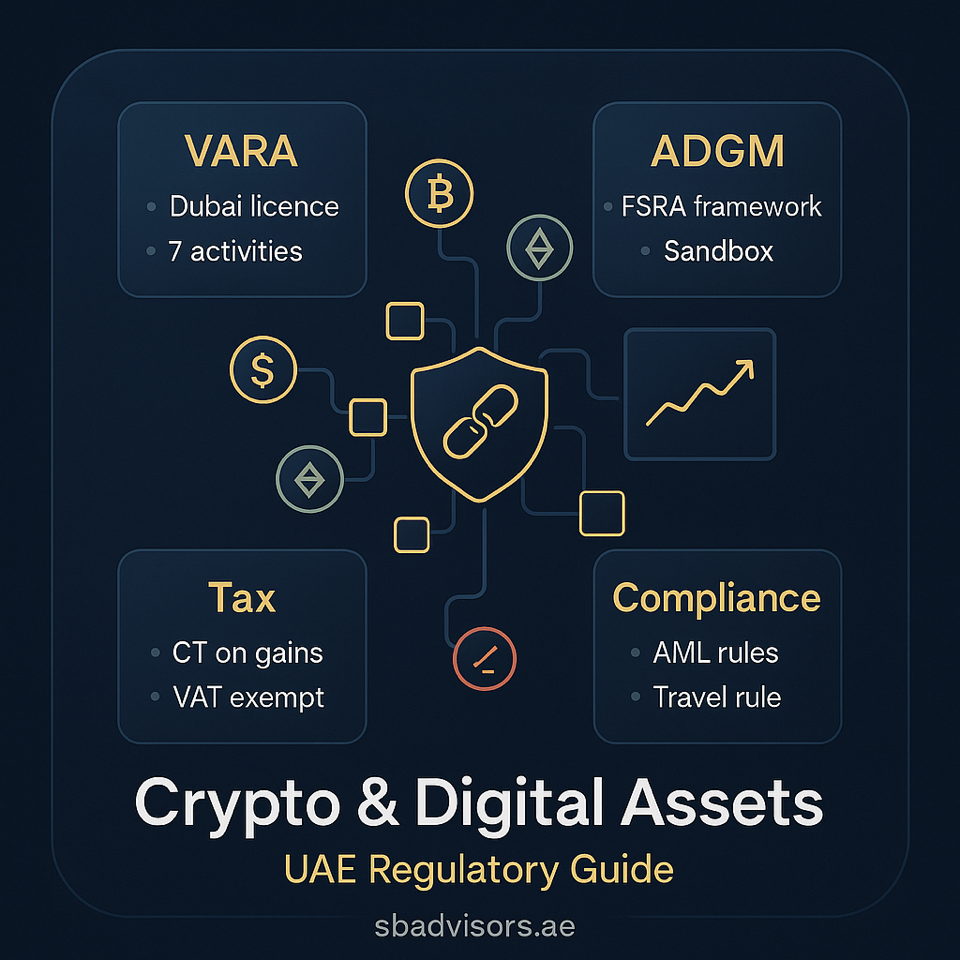
The UAE has positioned itself as one of the most crypto-friendly jurisdictions in the world, but “friendly” does not mean “unregulated.” Dubai’s Virtual Assets Regulatory Authority (VARA), ADGM’s Financial Services Regulatory Authority (FSRA), and the Securities and Commodities Authority (SCA) have each built detailed licensing and compliance frameworks.
If you operate a crypto exchange, offer custody services, issue tokens, or provide advisory services related to virtual assets in the UAE, you need a licence. Operating without one is a serious offence.
Quick answers
- Is crypto legal in the UAE? Yes. Virtual assets are legal and regulated. However, operating a virtual asset business without the appropriate licence is prohibited.
- Who regulates crypto in Dubai? VARA (Virtual Assets Regulatory Authority) for Dubai mainland and most Dubai free zones. DIFC has its own framework under the DFSA.
- Who regulates crypto in Abu Dhabi? The FSRA within ADGM for entities registered in ADGM. The SCA has broader federal oversight for securities-related tokens.
- Do I need a licence to trade crypto personally? No. Personal trading and holding of virtual assets does not require a licence. Licensing applies to businesses that provide virtual asset services to others.
- Is crypto income subject to UAE Corporate Tax? Yes. Gains from virtual asset trading by a business are taxable income under Corporate Tax at 9% above AED 375,000.
- Is VAT charged on crypto transactions? The transfer of virtual assets (crypto-to-crypto or crypto-to-fiat) is generally treated as exempt from VAT. Services related to virtual assets (advisory, custody fees) are standard-rated at 5%.
Regulatory Framework Overview
VARA (Dubai)
VARA was established in 2022 under Dubai Law No. 4 of 2022. It is the world’s first standalone regulator dedicated exclusively to virtual assets. VARA’s jurisdiction covers:
- Dubai mainland.
- Most Dubai free zones (except DIFC, which falls under DFSA).
VARA regulates seven categories of virtual asset activities:
- Advisory services: Providing advice on virtual asset transactions or portfolio management.
- Broker-dealer services: Acting as an intermediary in virtual asset transactions.
- Custody services: Safekeeping and management of virtual assets on behalf of clients.
- Exchange services: Operating a platform for buying, selling, or trading virtual assets.
- Lending and borrowing services: Facilitating virtual asset lending or borrowing.
- Transfer and settlement services: Transferring virtual assets between parties.
- Management and investment services: Managing virtual asset portfolios or investment vehicles.
Each activity requires a separate VARA licence or an endorsement on your existing licence.
ADGM FSRA (Abu Dhabi)
ADGM’s FSRA has regulated virtual assets since 2018 through its Financial Services and Markets Regulations (FSMR). Virtual assets are classified as “virtual assets” or “digital securities” depending on their characteristics.
Key features of the ADGM framework:
- A Regulatory Sandbox for early-stage crypto businesses to operate under modified requirements while building their compliance capabilities.
- Full licensing for established operators covering exchange, custody, and brokerage.
- Technology governance requirements, including cybersecurity standards and smart contract audit obligations.
DIFC (DFSA)
The DFSA regulates crypto tokens within the DIFC under its Investment Token framework. Recognised crypto tokens (currently Bitcoin and Ethereum) can be used in certain licensed activities. The DFSA framework is narrower than VARA or ADGM, focusing primarily on investment tokens.
SCA (Federal)
The SCA has federal oversight over securities-related tokens and has issued regulations on crypto asset activities. For tokens that qualify as securities, SCA licensing may apply in addition to or instead of VARA/FSRA licensing.
VARA Licensing Process
Step 1: Initial approval
Submit a preliminary application to VARA including:
- Business plan and description of virtual asset activities.
- Ownership structure and details of controllers and senior management.
- Compliance and risk management framework.
- Technology infrastructure description.
- Financial projections and capital adequacy.
VARA conducts a preliminary review and may request additional information or interviews.
Step 2: Minimum Viable Product (MVP) licence
VARA may issue an MVP licence that allows limited operations while you demonstrate compliance readiness. MVP conditions typically restrict the number of clients, transaction volumes, or product types.
Step 3: Full licence
After demonstrating compliance during the MVP phase, you apply for a full VARA licence. This requires meeting all regulatory standards including capital requirements, technology audits, and AML compliance.
Capital requirements
VARA sets minimum capital requirements based on the type and scale of activity. Exchange operators and custodians face higher capital thresholds than advisory firms. Specific figures are disclosed during the application process and vary by risk profile.
Tax Treatment of Virtual Assets
Corporate Tax
Virtual asset trading by a UAE business is subject to Corporate Tax on the same basis as any other business activity:
- Trading gains are taxable income at 9% above AED 375,000.
- Losses from virtual asset trading can offset other taxable income (subject to general loss relief rules).
- Inventory vs. capital asset: How you classify virtual assets (trading stock vs. investment) affects the timing of income recognition. Frequent traders should treat crypto as trading stock; long-term holders may argue for capital treatment, though the distinction under UAE Corporate Tax is less material than in some other jurisdictions.
For free zone entities, virtual asset activities may qualify for the 0% rate if the entity meets all QFZP conditions and the activities fall within qualifying activities.
VAT
The FTA has provided limited formal guidance on VAT treatment of virtual assets, but the general position is:
- Crypto-to-crypto and crypto-to-fiat exchanges: Treated as exempt financial services (similar to foreign exchange transactions). No VAT is charged on the exchange itself.
- Mining income: The VAT treatment depends on whether mining constitutes a supply of services. If mining is performed for a specific client, it may be standard-rated.
- Service fees: Advisory fees, custody fees, platform subscription fees, and other service charges related to virtual assets are standard-rated at 5%.
- NFTs: The sale of NFTs that represent digital goods or services is likely standard-rated at 5%. NFTs representing financial instruments may fall under exempt financial services. The classification depends on the specific characteristics of the NFT.
Personal holdings
The UAE does not tax personal income. Individual gains from holding and trading virtual assets are not subject to Corporate Tax (unless the activity constitutes a business). There is no capital gains tax for individuals.
AML Compliance for Virtual Asset Service Providers
All licensed virtual asset service providers (VASPs) must comply with UAE AML regulations, which are aligned with FATF standards. Key requirements:
- Customer Due Diligence (CDD): Full KYC on all clients, including identity verification, source of funds, and beneficial ownership identification.
- Transaction monitoring: Real-time monitoring of transactions for suspicious patterns, including chain analysis tools for on-chain transactions.
- Travel Rule: When transferring virtual assets above specified thresholds, VASPs must transmit originator and beneficiary information to the receiving VASP. This is a FATF requirement that the UAE actively enforces.
- Suspicious Transaction Reports (STRs): File STRs with the UAE FIU through goAML for any transactions that raise red flags.
- Sanctions screening: Screen all clients and counterparties against UAE, UN, and other applicable sanctions lists.
- Record keeping: Maintain all CDD and transaction records for at least five years.
Non-compliance with AML obligations can result in licence revocation, fines up to AED 5 million, and criminal prosecution.
Accounting for Virtual Assets
Virtual assets create specific accounting challenges:
- Classification: Under IFRS, virtual assets may be classified as intangible assets (IAS 38) or inventory (IAS 2) depending on the business model. Neither standard was designed for crypto, which creates practical challenges.
- Fair value measurement: If classified as intangible assets, the revaluation model requires a reliable fair value measurement. For actively traded tokens, market prices are available. For illiquid tokens, valuation requires more judgement.
- Impairment: Under the cost model (IAS 38), crypto assets must be tested for impairment. If the price drops below cost, an impairment loss is recognised. If the price recovers, the loss is not reversed (under the cost model).
- Revenue recognition: For exchanges, revenue is the commission/fee charged on transactions, not the gross transaction volume.
Proper accounting is essential for both audit compliance and accurate Corporate Tax filing.
Frequently Asked Questions
Do I need a VARA licence to offer crypto advisory services in Dubai? Yes. Advisory services related to virtual assets are one of the seven regulated activities under VARA. Operating without a licence is prohibited and can result in fines and criminal prosecution.
Can I set up a crypto exchange in a UAE free zone? Yes, depending on the free zone. In Dubai free zones (except DIFC), VARA licensing applies. In ADGM, FSRA licensing applies. In DIFC, DFSA licensing applies with a narrower scope. Other free zones may require SCA approval for securities-related tokens.
Is Bitcoin legal in the UAE? Yes. Bitcoin and other virtual assets are legal to hold, buy, sell, and trade. Businesses providing services related to virtual assets must be licensed.
How are crypto-to-crypto trades taxed? For businesses, each trade is a taxable event. The gain or loss on disposal is calculated as the difference between the proceeds (fair value of the asset received) and the cost base of the asset disposed of. For individuals, no tax applies.
Does the UAE enforce the FATF Travel Rule for crypto? Yes. The UAE actively enforces the Travel Rule, which requires VASPs to transmit originator and beneficiary information for virtual asset transfers above specified thresholds.
Can a free zone crypto company qualify for 0% Corporate Tax? Potentially, if the entity meets all QFZP conditions. The virtual asset activities must fall within qualifying activities, and the entity must not exceed the de minimis threshold for non-qualifying revenue.
How should I account for staking rewards? Staking rewards are generally recognised as income at fair value when received. For Corporate Tax purposes, they are taxable income in the period they are earned or received.
How Success Business Advisors can help
We advise on the financial and tax structuring of virtual asset businesses, prepare Corporate Tax returns with correct crypto gain/loss calculations, manage VAT classification, and coordinate with VARA or FSRA during the licensing process. Book a consultation and we will assess your regulatory and tax position in 30 minutes.
Ready to take the next step?
Schedule an Appointment WHO WE WORK WITH