How UAE Double Taxation Agreements Work: A Practical Guide
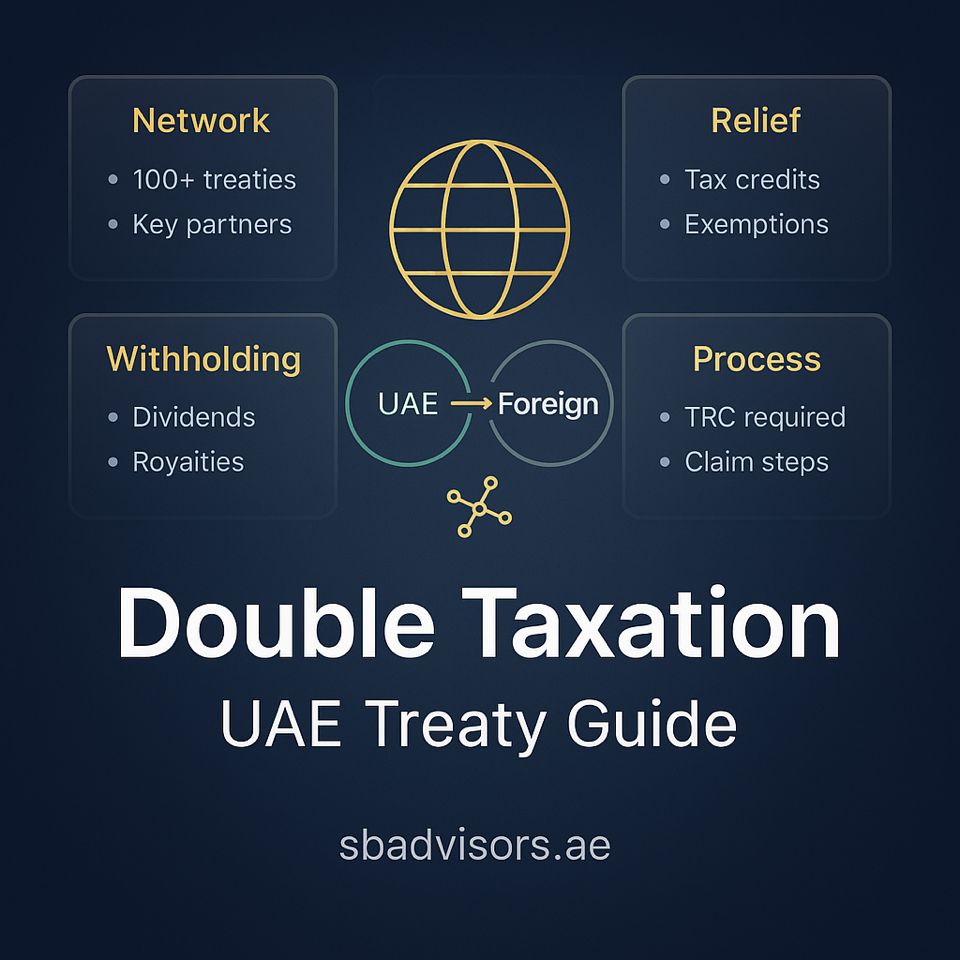
The UAE has signed Double Taxation Agreements (DTAs) with over 100 countries. These treaties are one of the most powerful, and most underused, tools available to UAE-based businesses and individuals with cross-border income.
A DTA can eliminate or reduce the tax that a foreign country imposes on income flowing to or from the UAE. But treaties do not apply automatically. You need to know what relief is available, how to claim it, and what documentation the foreign tax authority will demand.
Quick answers
- What is a DTA? A bilateral agreement between two countries that prevents the same income from being taxed twice and allocates taxing rights between them.
- How many DTAs does the UAE have? Over 100, including with India, the UK, France, Germany, China, Singapore, and most major trading partners.
- What taxes do they cover? Primarily withholding taxes on dividends, interest, and royalties. Some also cover capital gains and business profits.
- Do I need a TRC to use a DTA? Yes. A Treaty Tax Residency Certificate from the UAE FTA is required to prove you are a UAE tax resident for treaty purposes.
- Does the DTA apply automatically? No. You must claim relief, usually by submitting forms and your TRC to the foreign tax authority or withholding agent.
- Can individuals use DTAs? Yes, if they are UAE tax residents and the treaty covers the relevant income type.
How Double Taxation Agreements Work
A DTA divides taxing rights between two countries (the “Contracting States”). For each type of income, the treaty specifies:
- Which country can tax it (exclusive right to one country, or shared taxing rights).
- At what maximum rate (reduced withholding rates compared to the foreign country’s domestic rate).
- How to eliminate double taxation (credit method or exemption method).
The problem DTAs solve
Without a treaty, a UAE company receiving dividends from an Indian subsidiary might face 20% Indian withholding tax on those dividends. With the UAE-India DTA, the withholding rate can be reduced to 10% (subject to conditions).
For a business receiving AED 1 million in annual cross-border dividends, that is AED 100,000 in tax savings per year.
Key Income Types Covered by DTAs
Dividends
Most UAE DTAs reduce withholding tax on dividends paid from the foreign country to a UAE resident. Typical treaty rates:
- 10-15% for portfolio dividends (below a certain ownership threshold).
- 5-10% for substantial holdings (typically 10%+ or 25%+ ownership of the paying company).
- Some treaties provide 0% withholding in specific circumstances.
Without the treaty, the foreign country’s domestic withholding rate applies, which can be 20-30% or more.
Interest
DTAs typically reduce withholding tax on interest payments to 0-10%, compared to domestic rates that can be 15-30%.
This matters for:
- UAE companies that have lent money to foreign subsidiaries or affiliates.
- UAE holding structures that receive interest from overseas group entities.
- UAE banks and financial institutions with cross-border loan portfolios.
Royalties
Royalties (payments for the use of intellectual property, trademarks, patents, or know-how) are typically taxed at 0-10% under UAE DTAs, versus domestic rates of 10-30%.
This is particularly relevant for UAE businesses that license IP to or from entities in treaty countries.
Business profits
Under most DTAs, business profits of a UAE enterprise are only taxable in the foreign country if the UAE enterprise has a Permanent Establishment (PE) there. If there is no PE, the foreign country cannot tax the profits.
This is critical for UAE service companies, consultancies, and trading businesses that have clients in foreign countries but no physical presence there.
Capital gains
Treaty treatment of capital gains varies significantly. Some DTAs give exclusive taxing rights to the country of residence (the UAE), while others allow the source country to tax gains on immovable property or substantial shareholdings.
The UAE’s Treaty Network: Key Partners
| Treaty Partner | Dividends (%) | Interest (%) | Royalties (%) |
|---|---|---|---|
| India | 10 | 10 | 10 |
| United Kingdom | 0/15 | 0 | 0 |
| France | 0/5 | 0 | 0 |
| Germany | 5/15 | 0 | 0 |
| China | 5 | 7 | 10 |
| Singapore | 0/5 | 7 | 10 |
| Pakistan | 10/15 | 10 | 12 |
| Egypt | 5/10 | 10 | 10 |
Rates shown are indicative and subject to specific conditions in each treaty. Always verify the actual treaty text.
How to Claim Treaty Relief
Step 1: Confirm your UAE tax residency
You must be a tax resident of the UAE to invoke a DTA. This requires obtaining a Tax Residency Certificate (TRC) from the FTA.
For a Treaty TRC (as opposed to a Domestic TRC), the FTA requires:
- A valid UAE trade licence (for companies) or residency visa (for individuals).
- Evidence of UAE substance: office premises, employees, or business activity.
- A minimum period of presence in the UAE (for individuals).
Step 2: Identify the applicable treaty and article
Each treaty is structured in articles that cover different income types. Find the article relevant to your income (dividends, interest, royalties, business profits, etc.) and check the conditions and rates.
Treaties are published on the Ministry of Finance website and on tax treaty databases.
Step 3: Submit a claim to the foreign tax authority
The process varies by country:
- India: File Form 10F with your TRC and a tax residency declaration to the payer. The payer applies the reduced rate at source, or you file for a refund after assessment.
- UK: Submit a claim to HMRC with your TRC. For dividends from UK companies, relief may be automatic for treaty-rate countries.
- France: Submit a simplified claim form to the French tax authority with your TRC. Some claims require the payer to apply for relief on your behalf.
- Germany: File a Freistellungsbescheid application with the Bundeszentralamt fur Steuern (Federal Central Tax Office).
Each country has its own forms, timelines, and documentation requirements. Failure to follow the correct procedure means you pay the full domestic rate and must claim a refund, which can take months or years.
Step 4: Keep records
Maintain copies of:
- Your UAE TRC (renewed annually).
- The foreign forms submitted.
- Proof of income received and tax withheld.
- Correspondence with foreign tax authorities.
These records support your treaty position if challenged by either country and are part of your broader record-keeping obligations for Corporate Tax.
DTAs and UAE Corporate Tax
Since the introduction of UAE Corporate Tax in 2023, DTAs have become more relevant for UAE businesses:
- Foreign tax credits: If a foreign country taxes your income despite a DTA (or at a treaty-reduced rate), you can claim a Foreign Tax Credit against your UAE Corporate Tax liability. This prevents the same income from being taxed in both countries.
- PE risk: The DTA’s PE definition determines whether your foreign activities create a taxable presence abroad. Understanding this is essential for UAE companies with overseas clients or operations.
- Transfer pricing: Related-party transactions across borders must be at arm’s length, and the DTA’s associated enterprises article supports the transfer pricing rules.
Limitations of DTAs
DTAs are not a magic shield. Be aware of:
- Beneficial ownership: Most treaties require the recipient to be the “beneficial owner” of the income. Conduit arrangements (routing income through the UAE purely to access a treaty) can be challenged.
- Anti-avoidance provisions: Many modern treaties include Principal Purpose Test (PPT) clauses. If the main purpose of an arrangement is to obtain treaty benefits, the benefit can be denied.
- Substance requirements: Both the UAE (under Economic Substance Regulations) and foreign countries increasingly require genuine economic activity to support treaty claims.
- Domestic law overrides: Some countries have domestic anti-avoidance rules (like India’s GAAR) that can override treaty provisions in specific circumstances.
Frequently Asked Questions
Does the UAE have a DTA with the United States? No. The UAE and the US do not have a comprehensive DTA. Income flows between the two countries are subject to each country’s domestic tax rules without treaty relief.
Can I use a DTA to avoid all foreign taxes? No. DTAs reduce or allocate taxing rights, but they do not eliminate all taxes. The foreign country typically retains the right to tax at a reduced rate, and some income types (like immovable property gains) remain taxable at source regardless.
Do I need a new TRC every year? Yes. UAE TRCs are issued for specific financial years and must be renewed annually. Foreign tax authorities will require a current TRC for the year in which the income is received.
What if the foreign country refuses to apply the treaty rate? You can pay the full domestic rate and then claim a refund under the treaty. Most countries have a refund procedure, though timelines vary from weeks to years. You can also invoke the Mutual Agreement Procedure (MAP) under the treaty, where the two countries negotiate the correct treatment.
Do free zone companies qualify for DTA benefits? Yes, provided the company is a UAE tax resident and meets the treaty’s conditions. Qualifying Free Zone Persons are UAE tax residents and can access DTAs. However, some countries may scrutinise free zone entities more closely for substance.
How does a DTA interact with the UAE 0% Corporate Tax rate for free zones? If a free zone company pays 0% UAE Corporate Tax on qualifying income, some treaty partners may argue that the reduced treaty rate should not apply because no actual double taxation occurs. This is a grey area and depends on the specific treaty and the foreign country’s interpretation.
Can individuals use DTAs for employment income? Yes. Most DTAs include articles on employment income that determine which country can tax salary based on where the work is performed and the duration of stay. This is particularly relevant for UAE residents who work temporarily in treaty countries.
How Success Business Advisors can help
We identify which UAE DTAs apply to your cross-border income, manage TRC applications, prepare the foreign claim forms, and ensure your Corporate Tax return reflects the correct foreign tax credits. Book a consultation and we will map your treaty relief opportunities in 30 minutes.
Ready to take the next step?
Schedule an Appointment WHO WE WORK WITH