Business Insurance in the UAE: What's Mandatory, What's Smart, and What to Skip
Insurance is one of those compliance areas that UAE business owners either over-buy (because a broker upsold them) or ignore entirely (until something goes wrong). Neither approach is smart.
Some insurance is legally mandatory. Some is not legally required but would be reckless to skip. And some is a waste of money for your specific business. This guide helps you tell the difference.
Quick answers
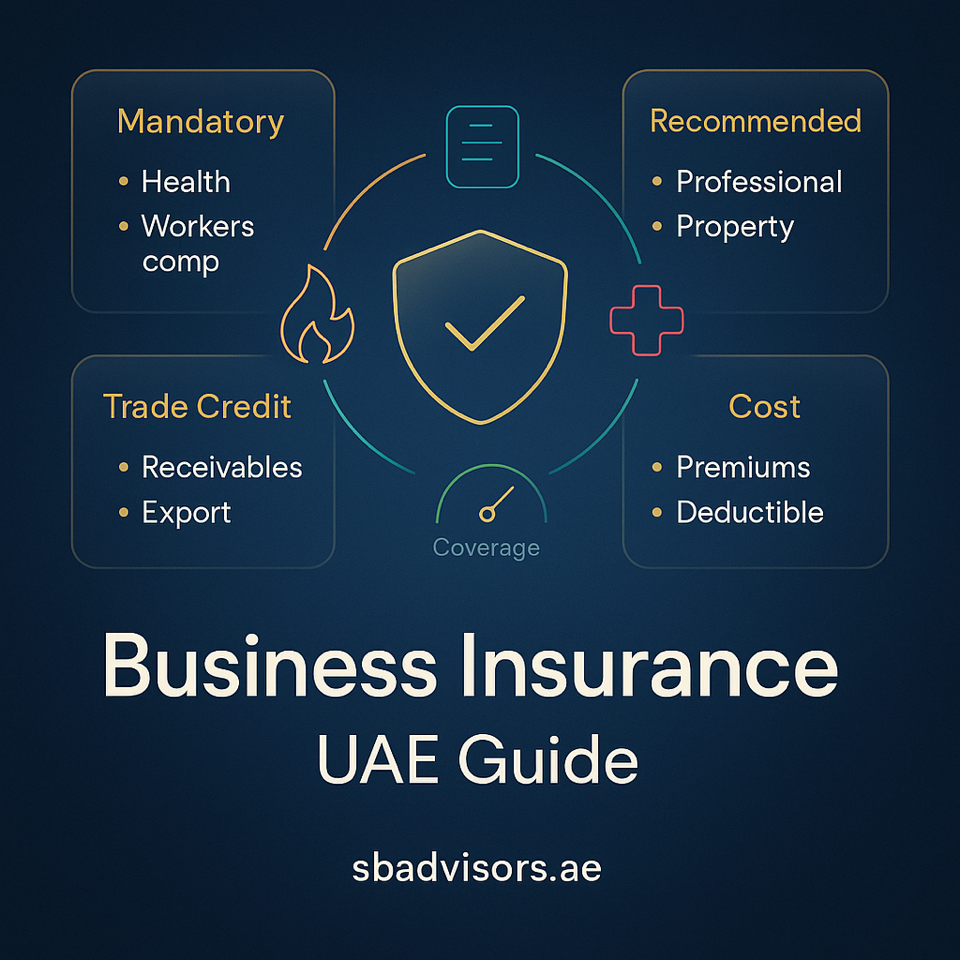
- What insurance is mandatory in the UAE? Employee health insurance (in Dubai and Abu Dhabi), workers’ compensation / work injury cover (federal requirement under labour law), and motor vehicle insurance for business vehicles.
- Is professional indemnity insurance required? Not universally, but several regulators and free zones mandate it for professional service firms (consultants, auditors, lawyers, healthcare providers, financial advisers).
- Are insurance premiums tax-deductible? Yes. Business insurance premiums are fully deductible for Corporate Tax purposes.
- Is there VAT on insurance premiums? No. Insurance and reinsurance services are exempt from VAT under UAE VAT law.
- How much does business insurance cost? It varies enormously. Basic health insurance for a small team starts at AED 500-700 per employee per year. Professional indemnity starts at AED 2,000-5,000 annually for small firms.
- Where do I buy business insurance? Through a licensed insurance broker or directly from an insurer regulated by the Central Bank of the UAE (CBUAE).
Mandatory Insurance
1. Employee health insurance
Dubai: All employers must provide health insurance to employees and their dependents (if sponsored). This is mandated by Dubai Health Authority (DHA) Law No. 11 of 2013. The minimum coverage is the Essential Benefits Plan (EBP), which has defined benefits and maximum premiums set by DHA.
Abu Dhabi: Mandatory under Abu Dhabi Health Authority regulations. The Thiqa scheme covers UAE nationals; employers must provide private health insurance for expatriate employees.
Other emirates: While federal law encourages employer-provided health insurance, enforcement varies outside Dubai and Abu Dhabi. In practice, most employers across all emirates provide health insurance because it is required for visa issuance and renewal.
Key compliance points:
- Insurance must be in place before the employee’s visa is issued or renewed.
- Gaps in coverage (e.g., between policy renewals) can trigger visa processing delays.
- The employer, not the employee, is responsible for the cost of the basic plan. Employees can upgrade at their own expense.
2. Workers’ compensation / work injury insurance
UAE Labour Law (Federal Decree-Law No. 33 of 2021) requires employers to provide compensation for workplace injuries, occupational diseases, and death during employment. While the law does not explicitly mandate a standalone insurance policy, the financial exposure is significant enough that workers’ compensation insurance is effectively required for any responsible employer.
Many free zones and mainland licensing authorities require proof of workers’ compensation cover as a condition of licence issuance or renewal.
3. Motor vehicle insurance
All vehicles registered in the UAE must have at minimum third-party liability insurance. For business fleets, comprehensive cover is standard and typically required by leasing companies.
Strongly Recommended Insurance
These are not legally mandatory for most businesses but are financially reckless to skip.
Professional indemnity (PI) insurance
Covers claims arising from professional negligence, errors, or omissions in the services you provide. Essential for:
- Consultants and advisors (management, IT, financial).
- Accountants and auditors.
- Lawyers.
- Architects and engineers.
- Healthcare providers.
- Real estate brokers.
Many free zones and sector regulators mandate PI insurance. DIFC and ADGM require it for all regulated firms. Even where not mandated, a single professional negligence claim can exceed your annual revenue.
Typical cost: AED 2,000-15,000 per year for small professional firms, depending on the limit of indemnity, sector, and claims history.
General liability (public liability) insurance
Covers claims from third parties for bodily injury or property damage arising from your business operations. Important for:
- Retail businesses with customer-facing premises.
- Restaurants and hospitality venues.
- Event companies.
- Construction and maintenance firms.
- Any business with visitors to its premises.
Typical cost: AED 1,000-5,000 per year for small businesses.
Property and contents insurance
Covers damage to or loss of your business premises, equipment, inventory, and fixtures from fire, flood, theft, or other insured perils.
If you hold inventory (particularly for e-commerce businesses with warehouse stock), property insurance is critical. A warehouse fire or flood can wipe out your entire inventory and, with it, your ability to fulfil orders.
Trade credit insurance
Covers losses from customers who fail to pay. Particularly valuable for:
- Trading companies with large receivables.
- Businesses with concentrated customer risk (a few large clients).
- Exporters selling on credit terms to foreign buyers.
Trade credit insurance also improves your cash flow position because insured receivables are treated more favourably by banks for trade finance facilities.
Cyber insurance
Covers losses from data breaches, ransomware, system outages, and related incidents. Increasingly important as the UAE Personal Data Protection Law (PDPL) creates financial exposure for data breaches.
Relevant for any business that stores customer data, processes payments online, or relies on digital infrastructure.
Key person insurance
Covers the financial impact of losing a critical individual (founder, key salesperson, lead technical person) due to death or disability. Useful for startups where one or two people drive most of the revenue.
Directors’ and officers’ (D&O) insurance
Covers personal liability of directors and officers for decisions made in their capacity. Relevant for companies with boards, particularly in DIFC and ADGM where directors face regulatory exposure.
Insurance You Can Probably Skip
- Business interruption (for very small businesses): If your annual revenue is under AED 500,000 and you could restart operations quickly from home, the premium may not justify the cover.
- Product liability (if you only provide services): Only relevant for businesses that manufacture, import, or sell physical products.
- Marine cargo (if you don’t import/export): Only relevant for trading companies moving goods internationally.
- Fidelity guarantee (for solo operators): Covers employee theft. If you have no employees, it adds no value.
Tax Treatment of Insurance
Corporate Tax
All business insurance premiums are deductible expenses for Corporate Tax purposes, provided they are incurred wholly and exclusively for business purposes. This includes:
- Health insurance for employees.
- Professional indemnity.
- Property insurance.
- General liability.
- Trade credit insurance.
- Cyber insurance.
- D&O insurance.
Insurance payouts (claims received) are generally treated as income or a reduction in the related expense/loss, depending on the nature of the claim.
VAT
Insurance and reinsurance services are exempt from VAT under UAE VAT law. This means:
- No VAT is charged on insurance premiums.
- The insurer cannot recover input VAT on its own costs (which may indirectly affect pricing).
- As a policyholder, you do not need to worry about input VAT recovery on premiums, because there is none to recover.
How to Buy Business Insurance in the UAE
- Use a licensed broker or insurer. All insurance providers must be licensed by the CBUAE. Do not buy insurance from unlicensed intermediaries.
- Get multiple quotes. Premiums for the same cover can vary 30-50% between insurers. A broker can run a market exercise.
- Read the policy wording. Pay attention to exclusions, deductibles (excess), territorial limits, and claims notification requirements.
- Match cover to actual risk. Do not over-insure (insuring AED 10 million of inventory when you hold AED 500,000) or under-insure (insuring AED 100,000 when your warehouse holds AED 2 million).
- Review annually. As your business grows, your insurance needs change. Add cover when you hire more staff, open new premises, or enter new markets.
Frequently Asked Questions
Is health insurance mandatory for all UAE employers? In Dubai and Abu Dhabi, yes. In other emirates, it is required in practice for visa issuance and renewal even where the legal mandate is less explicit.
Do free zone companies need professional indemnity insurance? Many free zones require it for professional service activities. DIFC and ADGM mandate it for all regulated firms. Check your specific free zone’s licence conditions.
Are insurance premiums subject to VAT? No. Insurance services are exempt from VAT in the UAE.
Can I deduct insurance premiums against Corporate Tax? Yes. All business insurance premiums are fully deductible if incurred for business purposes and properly documented.
What happens if I don’t provide health insurance to my employees? In Dubai, DHA can impose fines and your ability to process or renew employee visas will be blocked. In Abu Dhabi, similar enforcement applies through the health authority.
Is workers’ compensation insurance legally required? UAE Labour Law requires employers to compensate employees for workplace injuries. While a standalone policy is not explicitly mandated, the financial liability makes insurance effectively necessary. Many licensing authorities require proof of cover.
How much does cyber insurance cost for a small UAE business? For a small business with basic digital exposure, cyber insurance typically costs AED 3,000-10,000 per year, depending on the limit of cover, industry, and data volumes.
How Success Business Advisors can help
We assess your actual insurance needs based on your business structure, sector, and risk profile, and connect you with competitive quotes from licensed insurers. We also ensure your premiums are correctly treated in your accounting and Corporate Tax return. Book a consultation and we will review your coverage in 30 minutes.
Ready to take the next step?
Schedule an Appointment WHO WE WORK WITH