Setting Up a Branch Office vs. a Subsidiary in the UAE: What Foreign Companies Need to Know
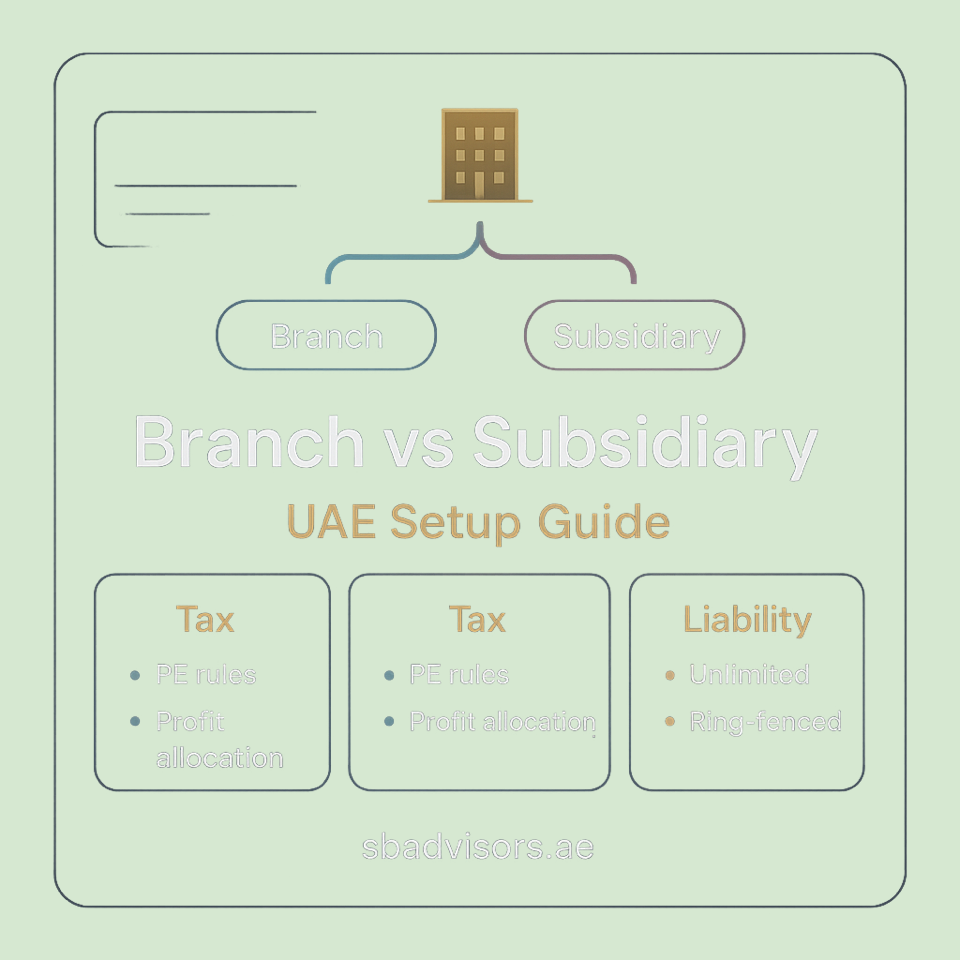
When a foreign company wants to establish a presence in the UAE, the first structural decision is whether to open a branch office or incorporate a subsidiary. These are fundamentally different legal structures with different implications for liability, taxation, profit repatriation, and ongoing compliance.
This is not the same question as mainland vs. free zone, which compares jurisdictions. A branch or subsidiary can be established in either location. The question here is about the legal relationship between the UAE entity and its foreign parent.
Quick answers
- What is a branch? An extension of the foreign parent company. It has no separate legal personality. The parent is directly responsible for all branch obligations.
- What is a subsidiary? A separate legal entity incorporated in the UAE. It has its own legal personality, assets, and liabilities, distinct from the parent.
- Which has more liability risk? A branch exposes the parent to unlimited liability for branch operations. A subsidiary limits liability to the capital invested in the subsidiary.
- Which is simpler to set up? A branch is generally faster and cheaper. A subsidiary requires incorporation, articles of association, and more regulatory steps.
- How does Corporate Tax differ? Both are subject to UAE Corporate Tax at 9%, but the taxable income calculation differs. A branch is taxed on profits attributable to its UAE operations. A subsidiary is taxed on its own worldwide income.
- Can both sponsor visas? Yes. Both a branch and a subsidiary can sponsor employee visas and residence permits.
Branch Office
Legal structure
A branch office is not a separate legal entity. It is a registered extension of the foreign parent company operating in the UAE. The branch operates under the parent’s name (often with “Branch” appended) and under the parent’s legal identity.
The parent company is directly liable for all obligations, debts, and liabilities of the branch. There is no legal separation between the branch and the parent.
Setting up a branch
- Choose a jurisdiction: A branch can be registered on the mainland (through DED in the relevant emirate) or in a free zone. Not all free zones permit branch registration; some require a new entity.
- Appoint a local service agent (mainland only): Mainland branches of foreign companies historically required a UAE national service agent. Following recent reforms, this requirement has been relaxed for many activity types, but check the specific emirate’s rules.
- Submit parent company documents: Certified copies of the parent’s certificate of incorporation, articles of association, board resolution approving the UAE branch, and audited financial statements.
- Register with the relevant authority: DED for mainland, or the free zone authority.
- Obtain the trade licence: The branch licence specifies the permitted activities, which must align with the parent’s business.
Activities permitted
A branch can generally perform the same activities as the parent company, subject to UAE licensing restrictions. However, a branch cannot perform activities that differ from the parent’s core business. If the parent is an engineering consultancy, the branch cannot trade in goods.
Advantages of a branch
- Speed and cost: Fewer incorporation steps. No need to draft articles of association or allocate share capital.
- Unified identity: The branch operates under the parent’s name and reputation.
- Profit repatriation: Branch profits can be remitted directly to the parent without dividend formalities (no shareholder resolutions or distribution restrictions).
- Simpler governance: No board of directors or shareholders’ meetings required at the branch level.
Disadvantages of a branch
- Unlimited liability: The parent is fully liable for all branch debts and obligations. A contract dispute or employee claim against the branch is a claim against the parent.
- Financial reporting: The parent must include branch financials in its consolidated accounts. Foreign auditors and regulators see the branch exposure.
- Limited flexibility: The branch cannot diversify beyond the parent’s activities.
- Perception: Some UAE clients and partners prefer dealing with a locally incorporated entity.
Subsidiary
Legal structure
A subsidiary is a separate UAE-incorporated company owned (wholly or partly) by the foreign parent. The most common structure is an LLC (Limited Liability Company), where the parent holds 100% of the shares (fully permitted since the 2020 FDI reforms for most activities).
The subsidiary has its own legal personality, its own assets and liabilities, and its own obligations. The parent’s liability is limited to its capital contribution.
Setting up a subsidiary
- Choose a jurisdiction and legal form: Mainland LLC, free zone company (FZCO/FZE), or a company in DIFC or ADGM.
- Draft memorandum and articles of association.
- Allocate share capital: Minimum share capital requirements vary by jurisdiction and activity.
- Register with the relevant authority: DED, free zone authority, or financial centre registrar.
- Obtain trade licence.
- Open a corporate bank account in the subsidiary’s name.
Advantages of a subsidiary
- Limited liability: The parent’s exposure is capped at its capital investment. Subsidiary debts do not flow up to the parent (absent guarantees).
- Local identity: Clients and partners deal with a UAE company, which may be preferred for government contracts, local tenders, and banking relationships.
- Activity flexibility: The subsidiary can conduct any licensed activity, not limited to the parent’s business.
- Clean separation: The subsidiary’s financials are separate from the parent’s until consolidated at group level.
- M&A flexibility: Selling the subsidiary is a share transfer. Selling a branch is a cessation and asset transfer, which is more complex.
Disadvantages of a subsidiary
- Higher setup cost: Incorporation fees, articles of association, share capital, and more regulatory steps.
- Dividend formalities: Profits are distributed as dividends, which require board/shareholder approval and must comply with the Companies Law (no distribution if the company’s net assets would fall below share capital).
- Governance requirements: Annual general meetings, director appointments, and compliance with UAE Companies Law.
- Audit requirements: Most subsidiary forms (LLCs, free zone companies) require annual statutory audits.
Tax Comparison
Corporate Tax
Both branches and subsidiaries are subject to UAE Corporate Tax at 9% on taxable income above AED 375,000. The key differences:
Branch:
- Taxed on profits attributable to the UAE permanent establishment. This requires profit attribution based on functions, assets, and risks in the UAE (similar to OECD PE profit attribution rules).
- If the parent is in a country with a DTA with the UAE, the treaty’s PE article governs how profits are allocated.
- The parent may also be taxed in its home country on branch profits, with a foreign tax credit for UAE Corporate Tax paid.
Subsidiary:
- Taxed as a standalone UAE entity on its own taxable income.
- Transfer pricing rules apply to all transactions between the subsidiary and the parent (or other related entities).
- Dividends paid by the subsidiary to the parent are generally exempt from UAE withholding tax (the UAE has no dividend withholding tax). The parent’s home-country treatment of those dividends depends on its domestic law and any applicable DTA.
VAT
Both branches and subsidiaries register for VAT independently if they meet the registration threshold (AED 375,000 in taxable supplies). There is no VAT grouping benefit unique to one structure over the other.
Free zone benefits
Both branches and subsidiaries in free zones can potentially qualify for the 0% Corporate Tax rate on qualifying income, provided they meet all QFZP conditions.
Profit Repatriation
Branch: Profits flow directly to the parent. No dividend declaration, no shareholder resolution, no distribution restrictions. The branch is the parent, so repatriation is internal.
Subsidiary: Profits are distributed as dividends, which require:
- Board approval.
- Shareholder resolution (if required by articles).
- Compliance with the Companies Law (net assets must exceed share capital after distribution).
- Proper documentation for banking and audit purposes.
The UAE does not impose withholding tax on dividends, so the repatriation itself is tax-free from the UAE side. The parent’s home-country tax treatment of received dividends is a separate matter.
Decision Framework
| Factor | Branch | Subsidiary |
|---|---|---|
| Setup speed | Faster | Slower |
| Setup cost | Lower | Higher |
| Liability | Unlimited (parent exposed) | Limited to capital |
| Activity scope | Same as parent only | Any licensed activity |
| Profit repatriation | Direct (no formalities) | Dividend (formal process) |
| Audit requirement | Varies by jurisdiction | Usually required |
| Local perception | “Foreign branch” | “UAE company” |
| Sale/exit | Complex (asset transfer) | Simple (share transfer) |
| Tax filing | Profit attribution | Standalone return |
Choose a branch when:
- You need a fast, low-cost entry to test the UAE market.
- Your operations will mirror the parent’s activities exactly.
- You want direct profit repatriation without formalities.
- The parent is comfortable with unlimited liability exposure.
Choose a subsidiary when:
- You need liability protection for the parent.
- You plan activities beyond the parent’s core business.
- You expect to sell or restructure the UAE operations later.
- Local identity and credibility matter (government contracts, banking).
- You want clean financial separation for reporting purposes.
Frequently Asked Questions
Can a branch office hire employees and sponsor visas? Yes. A registered branch can sponsor employee visas and residence permits, just like a subsidiary.
Does a branch need a local partner or service agent? Mainland branches historically required a UAE national service agent (not a partner with ownership). Recent FDI reforms have relaxed this for many activity categories. Free zone branches do not need a service agent.
Can I convert a branch into a subsidiary later? Not directly. You would need to incorporate a new subsidiary, transfer the branch’s assets, contracts, and employees to it, and then deregister the branch. This involves Commercial Tax, VAT, and employment law considerations.
Which structure is better for government contracts in the UAE? Subsidiaries are generally preferred. Some government tenders require the bidder to be a UAE-incorporated entity, which excludes branches.
Does the parent need to provide financial guarantees for the branch? Not formally in most cases, but the parent is already fully liable for the branch by operation of law. Banks and major clients may request parent company guarantees regardless of the structure.
Can a branch be part of a UAE Tax Group? A branch is not a separate juridical person, so it cannot form or join a Tax Group under the Corporate Tax Law. A subsidiary (as a separate company) can.
What happens to the branch if the parent company is dissolved? The branch ceases to exist because it has no independent legal personality. All branch assets and liabilities revert to the parent’s dissolution process.
How Success Business Advisors can help
We advise foreign companies on the right entry structure for the UAE, handle the registration and licensing, set up compliant accounting and tax filing, and manage the ongoing regulatory obligations. Book a consultation and we will assess which structure fits your situation in 30 minutes.
Ready to take the next step?
Schedule an Appointment WHO WE WORK WITH