Debt vs. Equity Financing for UAE Businesses: What Founders Need to Know
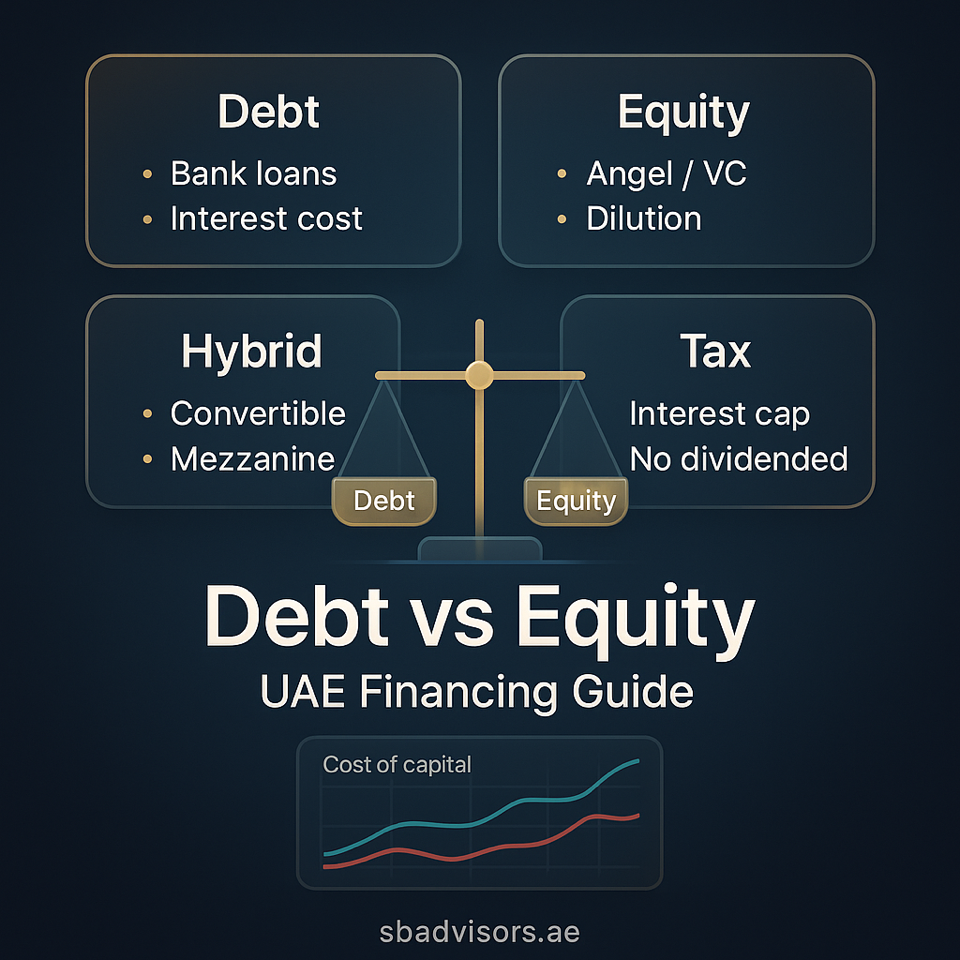
At some point, every growing UAE business needs capital beyond what the founders can put in or what operations generate. The question is whether to borrow it (debt) or sell a piece of the business for it (equity). Each path has fundamentally different implications for control, cost, tax treatment, and what happens when things go wrong.
This is not a theoretical exercise. The wrong capital structure decision has sunk more UAE SMEs than bad products ever have.
Quick answers
- What is debt financing? Borrowing money that you must repay with interest. The lender has no ownership stake.
- What is equity financing? Selling shares in your company to investors in exchange for capital. Investors become co-owners.
- Which is cheaper? Debt is usually cheaper in the short term (interest rates of 6-12% for UAE SME loans). Equity has no interest cost but the long-term dilution can be far more expensive if the company succeeds.
- Is interest deductible for Corporate Tax? Yes, but subject to the General Interest Deduction Limitation Rule (GIDLR): net interest above 30% of EBITDA is disallowed, with a de minimis carve-out of AED 12 million.
- Are dividends deductible? No. Dividends paid to shareholders are not a deductible expense. They are an appropriation of after-tax profit.
- Can I combine both? Yes. Most businesses use a mix. Convertible notes, mezzanine financing, and revenue-based financing blur the line between debt and equity.
Debt Financing in the UAE
Types of debt available
1. Bank term loans Traditional loans from UAE banks with fixed or variable interest, repaid over 1 to 7 years. Available from all major UAE banks (Emirates NBD, FAB, ADCB, Mashreq, RAK Bank, etc.).
Typical terms for SMEs:
- Interest rate: 6-12% per annum (varies by creditworthiness, collateral, and bank).
- Loan-to-value: 50-80% of collateral value.
- Collateral: Property, inventory, receivables, or personal guarantee from the business owner.
- Processing fee: 1-2% of the loan amount.
2. Business overdraft / revolving credit A credit line you draw on as needed. Interest is charged only on the amount used. Useful for cash flow management and working capital.
3. Trade finance Letters of credit (LCs), bank guarantees, and invoice discounting. Essential for import/export businesses and e-commerce operators who need to pay suppliers before collecting from customers.
4. Revenue-based financing (RBF) A newer model in the UAE where the lender advances capital in exchange for a percentage of monthly revenue until a fixed multiple is repaid (typically 1.3-1.8x the advance). No equity dilution, no fixed monthly payment. Repayment flexes with your revenue.
Providers like Lendis (Wio Bank), Clearco, and regional RBF platforms are active in the UAE market.
5. Government-backed financing Several UAE programmes support SME lending:
- Mohammed Bin Rashid Fund for SME (Dubai SME): Provides financing and guarantees for Dubai-based SMEs.
- Khalifa Fund (Abu Dhabi): Loans and equity investments for Abu Dhabi-based businesses.
- Emirates Development Bank (EDB): Federal development bank offering SME loans at competitive rates with government guarantee programmes.
These programmes often have lower interest rates and more flexible collateral requirements than commercial banks.
When debt makes sense
- You have predictable cash flow to service the repayments.
- You do not want to give up ownership or control.
- The cost of debt is lower than your expected return on the capital deployed.
- You have assets to pledge as collateral.
- The financing need is temporary (working capital, equipment purchase, project-based).
When debt is dangerous
- Your revenue is unpredictable or seasonal with no reserve to cover lean months.
- You are pre-revenue (most banks will not lend, and you should not want them to).
- The personal guarantee exposes your home or savings to risk.
- You are already leveraged and adding more debt pushes your debt-to-equity ratio into uncomfortable territory.
Equity Financing in the UAE
Types of equity
1. Angel investors High-net-worth individuals who invest personal funds in early-stage companies. Typical cheque sizes in the UAE: AED 100,000 to AED 1 million. Angels often provide mentorship and introductions alongside capital.
The UAE angel ecosystem has matured significantly, with networks like AstroLabs, Flat6Labs, and informal angel groups operating across Dubai and Abu Dhabi.
2. Venture capital (VC) Professional funds that invest institutional money in high-growth companies. UAE-based VCs include BECO Capital, Nuwa Capital, Shorooq Partners, Global Ventures, and others. Regional and international VCs (STV, Middle East Venture Partners) also invest in UAE companies.
Typical VC stages:
- Pre-seed / Seed: AED 500,000 to AED 5 million.
- Series A: AED 10 million to AED 50 million.
- Series B+: AED 50 million+.
3. Private equity (PE) For mature businesses, PE firms acquire significant or majority stakes, often with operational involvement. PE is not startup financing; it is growth or buyout financing for established businesses.
4. Strategic investors Companies in your industry that invest for strategic reasons (market access, technology, supply chain integration) rather than purely financial returns.
When equity makes sense
- You are pre-revenue or early-stage with no track record for bank lending.
- You need a large amount of capital relative to your current size.
- The business model requires significant upfront investment before generating returns.
- You want experienced investors who add strategic value beyond money.
- You are building for a high-growth outcome (exit via acquisition or IPO).
When equity is the wrong choice
- You are profitable and can fund growth from cash flow or modest debt.
- You do not want to share decision-making or board control.
- The business is a lifestyle business or slow-growth model, where equity investors will be frustrated by the lack of exit potential.
- The dilution at the current valuation is too severe.
Corporate Tax Implications
The choice between debt and equity has direct Corporate Tax consequences.
Interest (debt)
- Interest expense on business loans is deductible for Corporate Tax purposes.
- Subject to the GIDLR: Net interest expense exceeding 30% of EBITDA is disallowed. The de minimis carve-out of AED 12 million means most SMEs are unaffected.
- Disallowed interest can be carried forward for up to 10 tax periods.
- Interest paid to related parties (e.g., a shareholder loan) must be at arm’s length under transfer pricing rules.
Example: A company with AED 5 million EBITDA and AED 2 million net interest expense:
- 30% of EBITDA = AED 1.5 million.
- Deductible interest: AED 1.5 million.
- Disallowed: AED 500,000 (carried forward).
- But: if the AED 2 million is below AED 12 million (it is), the de minimis applies, and the full AED 2 million is deductible.
Dividends (equity)
- Dividends paid to shareholders are not deductible. They are an appropriation of after-tax profit.
- This means equity-funded businesses effectively pay Corporate Tax on the profits before distributing them, with no tax relief for the cost of equity capital.
- For the investor: dividends received by a UAE corporate shareholder from another UAE company are generally exempt (participation exemption), so there is no double taxation at the corporate level.
The tax shield
Debt creates a “tax shield” because interest reduces taxable income. Equity does not.
Example comparison:
- Company A (debt-financed): AED 10 million profit, AED 2 million interest. Taxable income: AED 8 million. Tax: ~AED 685,000.
- Company B (equity-financed): AED 10 million profit, AED 0 interest. Taxable income: AED 10 million. Tax: ~AED 866,000.
The debt-financed company saves AED 181,000 in Corporate Tax. This tax shield is one reason mature, profitable businesses prefer debt over equity.
Hybrid Instruments
Convertible notes
A loan that converts into equity at a future financing round, typically at a discount to the next round’s valuation (15-25% discount is standard). Popular for seed-stage funding because it defers the valuation discussion.
Tax treatment: Treated as debt (interest accrues, potentially deductible) until conversion, at which point it becomes equity.
SAFE (Simple Agreement for Future Equity)
Not debt. No interest. No maturity date. A contractual right to receive equity at a future event. Common in early-stage VC deals globally and gaining traction in the UAE.
Tax treatment: Not a deductible expense for the company. No interest deduction.
Mezzanine financing
A hybrid of debt and equity, typically subordinated debt with warrants or equity conversion rights. Used for growth-stage companies that are too mature for VC but need more capital than banks will provide.
Getting Investor-Ready
If you choose equity, investors will scrutinise your financial infrastructure before writing a cheque:
- Clean financial statements: Audited or reviewed financials prepared under IFRS.
- Tax compliance: VAT and Corporate Tax returns filed on time with no outstanding liabilities.
- Cap table clarity: Clean ownership structure, no undocumented side agreements.
- Projections: A credible financial model that ties to your budget and unit economics.
- Legal structure: The right entity type and jurisdiction. Many VCs prefer ADGM or DIFC holding structures for investable companies.
Frequently Asked Questions
Can I get a bank loan for a brand-new UAE company? Difficult. Most banks require 1-2 years of trading history and audited financials. Government-backed programmes (Dubai SME, Khalifa Fund, EDB) may have more flexible criteria for startups.
Is interest on a shareholder loan deductible? Yes, if the interest rate is at arm’s length and the loan has genuine commercial terms. If the FTA considers the rate excessive or the arrangement artificial, the excess interest will be disallowed.
What is the typical equity dilution at seed stage in the UAE? 15-25% for a seed round is common. This means the founders give up 15-25% of the company in exchange for the seed investment.
Do I lose control of my company if I take VC money? Not necessarily at seed stage. At Series A and beyond, VCs typically take board seats and may have veto rights on major decisions. The specific terms are negotiable.
Is revenue-based financing better than a bank loan? It depends. RBF is faster (days vs. weeks), requires no collateral, and payments flex with revenue. But the effective cost (1.3-1.8x multiple) can exceed bank loan interest if repaid quickly. For businesses with volatile revenue, the flexibility may justify the cost.
How does the Corporate Tax interest deduction limit work? Net interest expense (interest paid minus interest received) above 30% of EBITDA is disallowed. But the AED 12 million de minimis means most SMEs can deduct all their interest without hitting the cap.
Can a free zone company raise equity from foreign investors? Yes. Free zone companies allow 100% foreign ownership, which makes them attractive to international investors. DIFC and ADGM are the preferred jurisdictions for VC-backed companies due to their common-law legal frameworks.
How Success Business Advisors can help
We model the tax impact of your financing options, prepare investor-ready financial statements, structure shareholder loans at arm’s length, and ensure your cap table and Corporate Tax return reflect the chosen capital structure correctly. Book a consultation and we will review your financing strategy in 30 minutes.
Ready to take the next step?
Schedule an Appointment WHO WE WORK WITH