Family Business Governance and Family Office Setup in the UAE
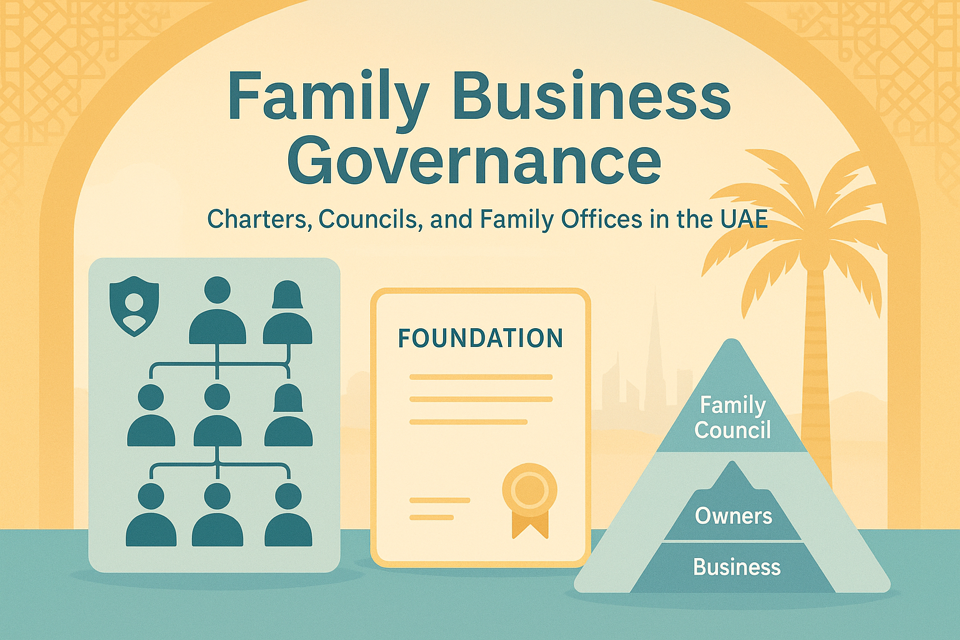
UAE family businesses built the country. Most of the iconic Emirati groups, and most of the largest expat-owned businesses in the country, started as a single founder’s vision and have grown into multi-generation enterprises that now employ thousands of people, span multiple sectors, and hold meaningful chunks of UAE GDP. The next ten to fifteen years are the period in which a generation of those businesses transitions from the founders to the second or third generation. The structures put in place now decide whether the family wealth compounds across that transition or fragments into shareholder disputes, forced sales, and litigation.
UAE law has caught up. The Federal Family Business Law (No. 37 of 2022) provides a legal framework for family business arrangements. ADGM and DIFC offer Foundations that work as succession vehicles. A single family office (SFO) based in DIFC or ADGM can manage the family’s investments, governance, and family-services functions in one place. This guide walks through the building blocks: charter, council, board, foundations, and family office.
Quick answers
- What is a family business charter? A non-binding document that captures the family’s values, vision, decision rules, and dispute resolution mechanisms. Foundational for everything else.
- What is a family council? A formal forum of family members that handles family-side governance separately from the operating company’s board.
- What is a single family office? An organisation set up to manage one family’s wealth, investments, and personal services. Distinct from the operating business.
- Where do most UAE families set up SFOs? ADGM (especially with Foundations) and DIFC are the dominant options. ADGM has been particularly active in private wealth and family office licensing.
- What is the UAE Family Business Law? Federal law providing a legal framework for family-owned businesses, including registration of family business arrangements with the relevant authority and incentives such as ten-year Corporate Tax exemption for qualifying registered family businesses (per the law’s specific provisions).
- Should we use a Foundation? Almost always for second-generation-plus families. A Foundation provides continuity, governance, and asset protection that a holding company alone does not.
The UAE Family Business Law (No. 37 of 2022)
The Federal Family Business Law was a landmark for the UAE family-business community. Headline features:
- Registration of family business arrangements with the competent authority allows families to formalise the rules for ownership, transfer, and governance of family business interests.
- Charters and shareholder agreements for registered family businesses gain enhanced legal recognition.
- Transfer restrictions and pre-emption rights can be enforced more cleanly under the law’s framework.
- Specific Corporate Tax incentives are available for qualifying registered family businesses (subject to the conditions set out in the law and the broader Corporate Tax framework).
Practically, the law is most useful for families that have already done the substantive work of charter-drafting and governance design. It gives that work a stronger legal home.
The Three-Layer Governance Model
Most modern family businesses use a three-layer governance model: family, owners, and business. Each has its own governance forum, with defined boundaries.
Layer 1: The Family
- Family charter: the foundational document. Captures family values, vision, principles, definition of “family member”, education and onboarding rules for next-gen members, employment policy (who can work in the business and on what terms), conflict resolution, and the decision rules for the family council itself.
- Family council / family assembly: the deliberative body of the family. Meets on a defined cadence. Discusses family matters that are not the operating business’s business: education of next gen, philanthropy, family services, conflict resolution.
- Family code of conduct: ethical and behavioural expectations.
The charter is non-binding in the strict legal sense, but it sets the cultural and operational tone. Families that have done the work to draft a real charter (with active participation from multiple generations) almost always handle disputes more constructively than those that have not.
Layer 2: The Owners
- Shareholder agreement: binding contract among the shareholders. Defines voting, transfer restrictions, drag/tag rights, dividend policy, and exit mechanisms.
- Holding company: typically an ADGM or DIFC SPV or holdco that owns the operating businesses.
- Family Foundation: sits above (or alongside) the holdco, owning the shares for succession purposes.
- Owners’ meeting / shareholders meeting: the governance forum of owners.
Layer 3: The Business
- Operating company / group: the business itself.
- Board of directors: including independent non-executive directors where the family is mature. Sets strategy, hires/fires the CEO, oversees risk and audit.
- CEO and management team: runs the business day-to-day.
The discipline is to keep these layers distinct. Family discussions happen in the family council. Owner decisions happen in the owners’ meeting. Business decisions happen in the board. Mixing them is the most common dysfunction in family businesses.
Foundations: The Succession Workhorse
A Foundation is a separate legal person, originally a civil-law concept, now offered through ADGM and DIFC under tailored regimes. Functionally similar to a trust, with different mechanics. Key features:
- Separate legal personality: the Foundation owns assets in its own name.
- No shareholders. A Foundation has a Founder (who establishes it), Beneficiaries (who benefit from it), and a Council (which manages it). No equity to be inherited or sold.
- Charter and Bylaws: define the purpose, beneficiaries, distribution rules, and governance.
- Continuity: the Foundation does not die when the Founder dies. It continues, governed by its charter, providing for beneficiaries across generations.
- Asset protection: subject to specific conditions and timing rules, assets in the Foundation can be protected from creditor claims against the Founder or beneficiaries.
- Privacy: information about beneficiaries is not publicly disclosed.
For a family business, the typical structure is:
Family Foundation (owns the shares)
    └── Holdco (owns the subsidiaries)
            ├── Operating subsidiary 1
            ├── Operating subsidiary 2
            └── Investment subsidiary
The Foundation owns the shares of the holdco. Beneficiaries are the family members per the charter. The Council manages the Foundation against the Founder’s documented intent. When the Founder dies, the Foundation continues; the operating businesses are not disrupted; succession is governed by the Foundation’s charter, not by external probate processes.
ADGM Foundations vs DIFC Foundations
Both regimes deliver the same essential outcome. Comparison:
| Feature | ADGM Foundation | DIFC Foundation |
|---|---|---|
| Year established | 2017 | 2018 |
| Use base | Strong adoption among Abu Dhabi families and international groups | Strong adoption among Dubai-anchored families and global wealth |
| Setup speed | Typically a few weeks | Typically a few weeks |
| Office requirement | Registered agent address sufficient | Registered agent address sufficient |
| Asset protection (claw-back) period | Defined under ADGM rules | Defined under DIFC rules |
| Charter / Bylaws structure | Charter (public) and Bylaws (private) | Charter and Bylaws |
| Migration | Foundations from other jurisdictions can migrate to ADGM | Foundations from other jurisdictions can migrate to DIFC |
Choice often follows where the rest of the family’s structure sits. A family with operating businesses in Abu Dhabi and a single family office in ADGM tends to put the Foundation in ADGM. A family with most of its UAE base in Dubai often chooses DIFC. The structural mechanics are very similar.
Single Family Office (SFO)
A single family office is an organisation that exists to serve one family. Functions typically include:
- Investment management: liquid portfolios, private market investments, real estate, art and collectibles.
- Governance support: secretariat for the family council, board, and committees.
- Tax and regulatory administration: Corporate Tax, VAT, UBO filings, Foundation administration.
- Family services: education planning for next gen, succession coaching, philanthropy.
- Concierge: travel, properties, lifestyle support.
When does a family need an SFO?
The classic threshold is around USD 100 million of investable assets, although the number is softer at the boundaries. Below that, a Multi-Family Office (MFO) or outsourced administration is usually more economic. Above, the cost of an SFO is justified by the value of dedicated, family-aligned management.
Where to set it up
- DIFC: the most established financial centre in the region, deep professional services ecosystem, strong base of family offices already operating there. The DIFC Single Family Office structure is well-defined.
- ADGM: rapidly growing, particularly attractive for families with Abu Dhabi or sovereign wealth ties, strong Foundations integration.
- Mainland or other free zones: less common, generally not the choice for a substantial SFO.
Licensing and substance
A regulated SFO needs a licence (under the relevant DIFC or ADGM family office regime), an office, qualified personnel, and a defined client base (the family). Substance requirements have to be met both for the local regulator and for any international tax planning that depends on UAE tax residence.
The Sequence: How to Build It
For most families, the sequence is:
- Charter first. Spend the time to draft a real charter with multi-generation family input. This is a 6- to 12-month exercise for serious families and pays back many times over.
- Council and code of conduct. Set up the family council. Run the first few meetings on the charter itself; the discipline of running the meetings is part of building the governance muscle.
- Holdco and Foundation. Restructure ownership: pull operating shares under a holdco, then put the holdco shares into a Foundation. This is the single biggest structural move.
- Shareholder agreement. Put a contractual framework in place among current owners alongside the Foundation arrangements.
- Board governance. Bring in independent non-executive directors. Separate ownership from management.
- SFO (when scale justifies). Set up the single family office in DIFC or ADGM with proper licensing, staffing, and substance.
- Wills. Each adult family member registers a DIFC or ADGM Will for their personal assets, complementing the Foundation arrangements for the business.
- Family Business Law registration. Register the family business arrangement with the competent authority for legal recognition and any available Corporate Tax incentives.
Tax and Regulatory Considerations
UAE Corporate Tax
- Holding companies and Foundations are Resident Persons. The participation exemption applies to qualifying dividends and capital gains.
- Family Business Law incentives (where applicable) provide specific tax treatment for qualifying registered family businesses.
- Transfer pricing applies to intra-family-group transactions and must be at arm’s length.
- Tax Group elections can simplify Corporate Tax for the operating subsidiaries; see our Tax Grouping guide.
Cross-border tax
For internationally mobile families, the UAE structure must work alongside foreign tax rules:
- Anti-deferral / CFC rules in countries where family members are resident.
- Foundations are characterised differently in different countries (transparent vs. opaque, trust-substitute vs. corporate). Local tax advice in each jurisdiction matters.
- Inheritance tax in countries where family members or assets are connected.
Regulatory
- UBO disclosure at the holdco and operating-subsidiary level.
- AML / KYC at the Foundation, holdco, and SFO levels.
- Substance for QFZP and DTA purposes.
Common Mistakes
- Building structure before charter. A perfectly designed Foundation that does not embed family-agreed principles solves a procedural problem and creates a governance vacuum.
- Treating the family council as ceremonial. Real governance comes from real meetings, real decisions, and real follow-through. Cosmetic governance is worse than none.
- No independent directors on the board. Pure-family boards struggle with strategic challenge and succession of management. One or two qualified independents transforms board effectiveness.
- Mixing operating and family roles. A family CEO who is also chair of the family council and trustee of the Foundation has more conflicts of interest than they can navigate.
- Skipping the SFO setup until “later”. Once asset complexity exceeds a certain threshold, the cost of operating without an SFO (in errors, duplicated work, missed opportunities) exceeds the cost of building one.
- Treating the next generation as employees-in-waiting. Families that invest in next-generation education, exposure, and decision-making earlier consistently transition more successfully.
- No registered Wills. The Foundation handles the business shares; personal estates still need DIFC or ADGM Wills for everything else.
Frequently Asked Questions
What is a family business charter? A foundational document setting out the family’s values, vision, principles, employment rules, conflict resolution, and the rules for the family council itself. Non-binding strictly, but the cultural and operational reference for all subsequent governance and structuring decisions.
What is the difference between a family council and the company board? The family council is the family’s deliberative body, focused on family matters (next generation, philanthropy, conflict resolution, the charter itself). The company board is the operating company’s governance body, focused on strategy, risk, and management oversight. They are separate, with separate meetings, members, and remits.
When does a family need a single family office? Typically once investable assets reach around USD 100 million, although the threshold is softer at the boundaries. Below this, multi-family-office (MFO) services or outsourced administration are usually more economic.
ADGM or DIFC for a family office? Both work. DIFC has a longer track record and a deeper ecosystem. ADGM has been particularly active in family office licensing and integrates strongly with ADGM Foundations. Choice often follows where the rest of the family structure sits.
What is a Foundation in the UAE context? A separate legal person that holds and manages assets according to a Charter and Bylaws set by the Founder, for the benefit of named or class beneficiaries. Used widely as a succession vehicle, sitting above the holding company and owning the family’s business interests.
Does the Family Business Law apply to expat-owned businesses? The Family Business Law applies to UAE-based family businesses generally, with specific provisions for registered family business arrangements. Expat-owned UAE businesses can register subject to meeting the law’s conditions; specific advice on eligibility is recommended.
Are Foundations subject to UAE Corporate Tax? Foundations can be treated as transparent (with Corporate Tax flowing through to the beneficiaries) or as a Resident Person, depending on their structure and the elections made. The participation exemption and other Corporate Tax mechanisms apply to qualifying flows.
How Success Business Advisors can help
We work with UAE family businesses and family offices on charter drafting, governance setup, holdco and Foundation structuring, single family office licensing in ADGM and DIFC, and the multi-year programme of moving from founder-led to professionally governed. Book a consultation and we will assess your family business governance position in 30 minutes.
Ready to take the next step?
Schedule an Appointment WHO WE WORK WITH