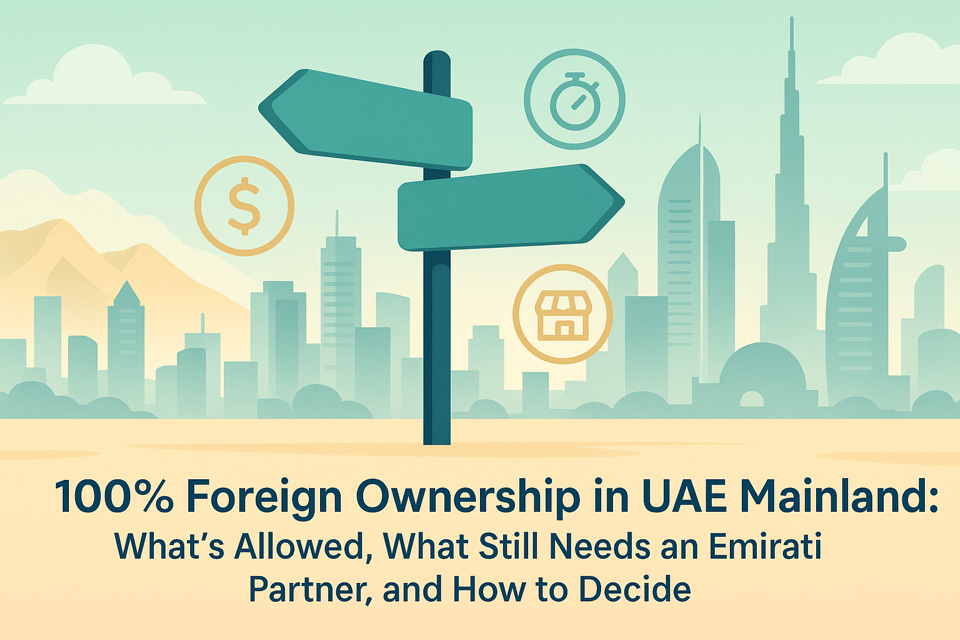
100% Foreign Ownership in UAE Mainland: What's Allowed, What Still Needs an Emirati Partner, and How to Decide
For decades the standard answer to “can I own a UAE mainland company outright?” was no. Foreign investors operating on the mainland needed an Emirati national to hold at least 51% of the shares, with a side-arrangement (a “nominee” or service agent) to allocate economic rights back to the foreign investor. The 2021 amendments to the UAE Commercial Companies Law (Federal Decree-Law No. 26 of 2020 and subsequent updates) transformed that. Most mainland activities now permit 100% foreign ownership. A defined list of strategic impact activities still requires Emirati participation under specific conditions, and certain professional activities sit in their own regulatory bucket.
The change matters more than the headline suggests. It removed a long-standing constraint that pushed many international businesses into free zones; it changed the calculus of mainland vs free zone setup; and it exposed a generation of legacy “nominee” structures to a cleaner, fully-compliant alternative. This guide explains what is now allowed, what still requires an Emirati partner, and how to choose between mainland and free zone today.
Quick answers
- Can I own 100% of a UAE mainland company? Yes for most activities. The 2021 amendments to the Commercial Companies Law removed the general 51% UAE-national requirement.
- What still requires an Emirati partner? A list of strategic impact activities maintained at the Emirate level. Examples include certain defence, security, and oil and gas activities. The list is published and updated.
- Are professional firms 100% foreign-owned? Many professional licences (consultancies, certain regulated professions) operate on a different basis, often using an Emirati service agent who has no equity but provides government liaison. The fee model differs from a 51% nominee.
- Does this change matter if I am already in a free zone? Yes. Free zone vs mainland is no longer a binary about ownership. Customer base, licensing scope, and tax treatment now drive the decision.
- Does 100% ownership change my tax position? No. UAE Corporate Tax and VAT apply identically regardless of ownership percentage.
- What about my existing nominee structure? It can usually be unwound to direct foreign ownership, often improving governance, banking, and dispute risk.
Background: How We Got Here
Before the 2021 amendments, mainland UAE limited liability companies were constrained by the 51% national rule. Foreign investors who wanted majority economic control commonly used:
- Nominee arrangements, where a UAE national held 51% on paper but assigned the economic rights back to the foreign investor under a separate agreement. Workable, but with persistent governance, banking, and litigation risk.
- Free zone setup, where 100% foreign ownership had always been available within the free zone’s geographic and activity boundaries.
- Branch structures, where a foreign company could open a branch on the mainland subject to specific licensing constraints.
The 2021 reform abolished the general 51% rule for the great majority of mainland activities. The detail of what is now possible is set Emirate-by-Emirate, in line with each Emirate’s economic and licensing authority.
What Is Open Now
Most mainland activities are open to 100% foreign ownership. The default position has flipped: the question used to be “is this activity in the open list?”; now it is “is this activity in the restricted list?”
Open categories typically include (subject to Emirate-level confirmation):
- General trading and import/export.
- Technology, software, IT services.
- Marketing, advertising, media production.
- Professional services (subject to specific professional licensing rules).
- Manufacturing and industrial activities.
- Logistics and transport (most categories).
- Real estate brokerage and property management.
- Hospitality, food and beverage.
- Education and training.
- Healthcare services (subject to MoH/HAAD/DHA licensing).
- Construction (most categories).
- E-commerce and digital businesses.
The exact open / restricted classification is determined by the Emirate-level economic authority (DED in Dubai, ADDED in Abu Dhabi, etc.) using the activity codes maintained by each Emirate.
What Still Requires an Emirati Partner
A defined list of strategic impact activities remains subject to Emirati ownership requirements. The list is published and updated by the federal cabinet, with implementation through the Emirate-level economic authorities. Indicative categories that historically appear on the strategic list (subject to current published lists, which should be checked before any decision):
- Defence and military activities.
- Security services.
- Banking, insurance, and certain financial services where regulator-specific rules require local participation.
- Oil and gas exploration and production (with project-specific arrangements via the relevant national operator).
- Certain telecommunications activities.
- Certain printing and publishing activities, in some Emirates.
- Hajj and Umrah services.
- Fisheries and certain extractive industries.
For activities on the strategic list, foreign investors typically work with Emirati partners or with Emirate-specific economic authorities to design a compliant ownership structure. The partnership terms are subject to the law’s protections (against under-the-table nominee arrangements).
Professional Licences and the Service Agent Model
Certain professional activities, even where 100% foreign-owned, traditionally use an Emirati service agent. The service agent:
- Holds no equity in the business.
- Provides government liaison and licensing facilitation.
- Receives an annual fee, not a profit share.
This model differs fundamentally from the old 51% nominee. The foreign investor owns 100% of the equity and economic rights; the service agent provides a service against a defined fee.
Professional categories where service agents are still common include certain engineering consultancy practices, legal consultancy (where allowed), and a small number of other professional licences. The exact requirements are activity-specific and Emirate-specific.
Mainland vs Free Zone: How to Choose Today
With 100% foreign ownership now available on the mainland, the choice between mainland and free zone has shifted. Different drivers now matter:
| Driver | Mainland | Free Zone |
|---|---|---|
| Foreign ownership | 100% in most activities | 100% historically |
| Mainland customer access | Direct, no service agent or branch needed | Restricted (free zone companies typically cannot supply mainland customers without specific arrangements) |
| Government tenders | Eligible directly; ICV scoring applies | Some tenders require mainland licensing; check tender terms |
| Tax | UAE Corporate Tax 9% above AED 375,000 | Same for non-qualifying free zone income; 0% qualifying free zone income for QFZP |
| Office requirement | Yes (real or flexi) | Often more flexible |
| Setup speed | 2 to 6 weeks | Often comparable; depends on jurisdiction |
| Visa quotas | Linked to office space | Linked to free zone package |
When mainland makes more sense now
- You are selling primarily to UAE mainland customers (B2B or B2C) and want to avoid free-zone-to-mainland constraints.
- Your customer base includes UAE government and government-related entities with direct procurement.
- You hold or trade UAE real estate as part of the business model.
- You operate in activities better served by mainland licensing (retail, F&B, healthcare, construction).
- You want simplest banking with no questions about mainland vs free zone status.
When free zone still makes more sense
- You are running an import-export or re-export hub that benefits from free zone customs treatment.
- You qualify for the 0% Qualifying Free Zone Person rate on qualifying activities. See our QFZP guide.
- You are in a sector where the relevant free zone provides regulatory expertise and ecosystem benefits (e.g., DIFC for financial services, Dubai Healthcare City for healthcare).
- You are operating from a single hub serving regional markets more than UAE local customers.
- Your customers are predominantly outside the UAE and free zone status meets your needs.
For an SME today, the answer is no longer “free zone by default for foreign ownership.” It is “mainland or free zone based on customers, tax, and operational fit.”
Practical Implications for Existing Structures
Legacy nominee arrangements
A 2018-vintage mainland LLC with a 51% Emirati nominee can usually be converted to 100% foreign ownership by:
- Confirming the activity is now open to 100% foreign ownership at the relevant Emirate.
- Negotiating the buy-out of the nominee’s paper shareholding (often at no economic cost given that there was no real economic interest, but legal costs and regulatory fees apply).
- Filing the share transfer with the DED and licensing authorities.
- Updating the trade licence, MoA, and any related contracts.
- Updating bank mandates, insurance, and customer/supplier records.
The cost is real (legal, regulatory, banking) but the benefits in governance, banking ease, and dispute risk reduction are usually material.
Existing free zone businesses considering mainland
Free zone businesses that have grown into substantial UAE-mainland customer bases sometimes consider relocating or supplementing with a mainland LLC. Options:
- Open a mainland branch of the free zone company.
- Set up a mainland LLC alongside the free zone entity, with a clear allocation of customers and activities.
- Migrate the free zone entity to a mainland licence, where eligible.
The right answer depends on tax treatment (QFZP impact), customer relationships, and operational continuity.
Tax: The Same, Regardless of Ownership
Critical to understand: UAE Corporate Tax and VAT treatment are determined by the company’s characteristics, not by the shareholder’s nationality. A 100% foreign-owned mainland LLC is a Resident Person at 9% on taxable income above AED 375,000, just like a 100% Emirati-owned mainland LLC. The same goes for VAT registration thresholds and obligations.
However, ownership changes can interact with:
- Tax loss carry-forward continuity tests, if combined with a change of business activity (see our loss carry-forward guide).
- Tax Group eligibility if the new structure changes the 95% common ownership requirement.
- QFZP status for free zone entities post-restructuring.
- DTA residence considerations for cross-border tax planning.
How to Set Up a 100% Foreign-Owned Mainland LLC
Step 1: Confirm activity classification
Engage with the relevant Emirate economic authority (DED Dubai, ADDED Abu Dhabi, or equivalent) to confirm:
- The activity code(s) and that they are open to 100% foreign ownership.
- Any sector-specific approvals needed.
- Whether a service agent is required for any of the activities.
Step 2: Choose a name and reserve it
Names must comply with naming rules (no offensive content, no government references, no abbreviations of personal names without justification). Reservation is online through the relevant authority’s portal.
Step 3: Prepare the constitutional documents
- Memorandum of Association (MoA): the founding document setting out shareholding, share capital, activities, governance, and term.
- Shareholders agreement (private contract among shareholders): voting rules, transfer restrictions, board composition, dividend policy.
- Articles of association (where required by the activity or Emirate).
Step 4: Submit the application
Through the Emirate authority’s portal. Submit shareholder identification, MoA, activity selection, office lease, and required approvals. Pay the licence fee.
Step 5: Open a corporate bank account
The longest single step in most cases. Plan for 6 to 12 weeks. KYC will cover the foreign UBO, source of funds, business model, and expected transaction profile.
Step 6: Register for tax and statutory matters
- FTA registration for Corporate Tax and (if thresholds met) VAT.
- GPSSA / pension registration if hiring UAE nationals.
- MoHRE establishment card for employment and WPS.
- Establishment registrations with relevant sector regulators (DHA/HAAD for healthcare, KHDA for education, etc.).
Step 7: Visa applications
Investor visas and employee visas are processed against the establishment card and quota.
Common Mistakes
- Assuming all mainland activities are open. They are not. Confirm the activity classification before signing leases or filing documents.
- Signing a “service agent” agreement that looks like a 51% nominee. A genuine service agent has no equity. An agreement that gives the agent profit-sharing or transfer rights is a different beast and may not comply with the law.
- Treating the 100% rule as a tax change. It is not. Tax treatment is determined by the company, not its shareholders.
- Underestimating the bank account timeline. Especially for a new mainland LLC with foreign UBO. Plan around it.
- Forgetting UBO disclosure requirements. 100% foreign ownership does not exempt the entity from UBO transparency.
- Choosing mainland just because of the ownership change when a free zone is still the right fit for the business model. The decision matrix has shifted, not disappeared.
Frequently Asked Questions
Can a foreign investor own 100% of a UAE mainland company? Yes, for most activities. The 2021 amendments to the UAE Commercial Companies Law removed the general 51% UAE national requirement. Specific strategic impact activities still require Emirati participation under conditions.
Which activities still need an Emirati partner? A defined list of strategic impact activities maintained at the federal level and implemented Emirate-by-Emirate. Examples typically include defence, security, certain oil and gas, and certain financial sector activities. Always check the current published list before deciding.
Is there still such a thing as a “service agent”? Yes, for certain professional licences. A service agent has no equity in the business, provides government liaison, and is paid an annual fee. This is different from a 51% nominee shareholder.
Should I move my free zone company to the mainland now that 100% ownership is allowed? Only where the business model warrants it. Free zone is still better for re-export hubs, QFZP-eligible activities, and regulatory ecosystems like DIFC or DHC. Mainland is better when the customer base is mainland UAE B2B / B2C or government tenders.
Does 100% ownership change my UAE Corporate Tax position? No. Tax treatment is determined by the company’s characteristics (activity, structure, free zone vs mainland, group composition), not by the nationality of its shareholders.
Can I buy out my 51% Emirati nominee and convert to 100% foreign ownership? Yes, for activities that are now open to 100% foreign ownership. The conversion involves a share transfer, MoA update, licensing update, and (typically) bank mandate changes. Engage legal advice on the buy-out terms.
What is the difference between mainland 100% ownership and a free zone? Mainland 100% ownership lets the foreign investor own a mainland-licensed entity that can serve mainland customers directly, take part in government tenders, and operate without free-zone-to-mainland restrictions. Free zone is still preferable where the activity benefits from free zone customs treatment, QFZP tax status, or the regulatory ecosystem of a specific zone.
How Success Business Advisors can help
We assess the right setup for foreign investors entering the UAE today: mainland LLC vs free zone vs branch, activity classification, professional licensing, and the right Emirate. Where existing nominee or 51% structures are in place, we plan and execute the conversion. Book a consultation and we will map your options in 30 minutes.
Ready to take the next step?
Schedule an Appointment WHO WE WORK WITH