ICV Certification in the UAE: How In-Country Value Scoring Wins Government Tenders
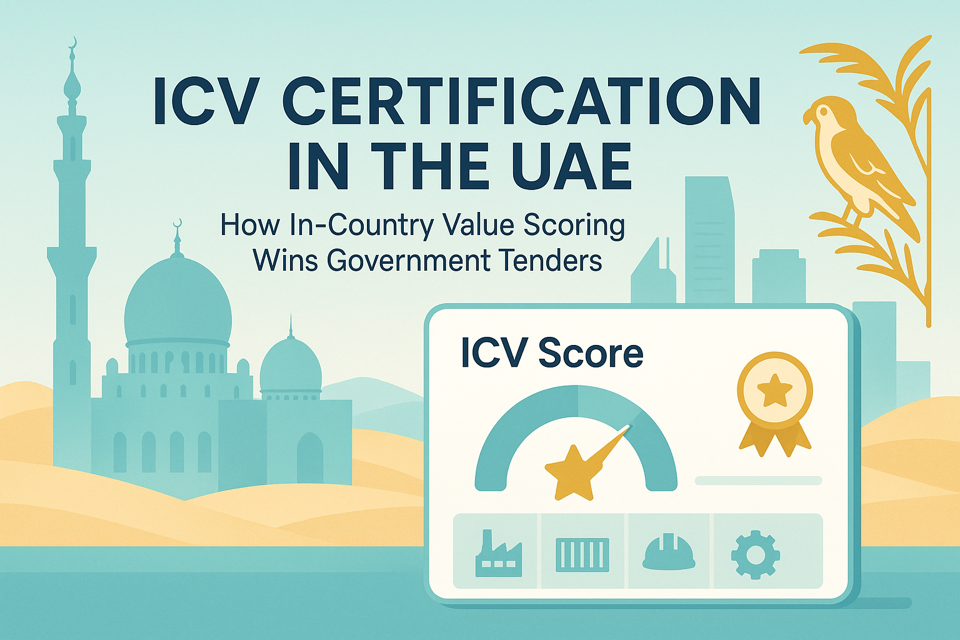
If your business sells, or hopes to sell, into UAE government and government-related entities, ICV certification is no longer a nice-to-have. It is the scoring layer that decides which bidder wins a meaningful share of the tens of billions of dirhams of UAE federal, ADNOC, and Emirati-owned procurement spend each year. A higher ICV score does not just open doors; it directly compensates for a higher headline price in tender evaluation.
Most SMEs first encounter ICV when a customer asks for a current ICV certificate as a precondition to issuing a purchase order. Many discover at that moment that their score is much lower than their narrative says. This guide explains how ICV certification actually works, the levers that move the score, and how to build the kind of programme that lifts the number in time for the next bid.
Quick answers
- What is ICV? In-Country Value is a scoring programme that quantifies how much of a supplier’s economic activity is conducted within the UAE. A higher score signals more local value-add and earns a tender evaluation premium.
- Who uses ICV? ADNOC was the early mover; the programme is now the National ICV Programme, used by federal entities and a wide range of government-related entities and corporates. Many private buyers also reference ICV in supplier evaluation.
- How is the score calculated? A composite of UAE-spend on goods, services, manufacturing, capital investment, Emiratisation, and certain other localised activities, divided by total revenue, with weights and bonuses defined in the official guidelines.
- How long does certification take? Typically 4 to 8 weeks from engagement of an Empanelled Certifying Body to issuance, assuming clean source data.
- Who issues the certificate? Empanelled Certifying Bodies (ECBs), audit firms approved under the programme. The certificate is signed and stamped by the ECB.
- What does it cost? Audit fees vary by company size and complexity, typically AED 15,000 to AED 60,000 for SMEs.
- How long is it valid? 14 months from the audited financial year-end (or 10 months for the first certification cycle, depending on the rules in force).
Why ICV Matters
ICV is a price-equivalent uplift. In tender evaluation, the buyer takes the bidder’s commercial price and applies an “ICV-equivalent” reduction proportional to the bidder’s ICV score. A bidder with a higher ICV is effectively scored as if their bid was lower than its headline number.
The typical formula:
Adjusted price = Commercial price × (1 − Weight × ICV score)
Where the weight is set by the buyer (commonly 10% to 20%, sometimes higher in priority sectors). A bidder with a 50% ICV score and a 20% weight is scored as if their price was 10% lower than the commercial bid.
That margin is decisive. In competitive tenders the difference between winner and runner-up often comes down to a few percent of price-equivalent. ICV is a reliable mechanism to close (or open) that gap.
How the ICV Score Is Built
The score is a composite. While the exact weightings have evolved through programme updates, the structural drivers are:
1. UAE Spend on Goods and Services
The single biggest line. Procurement from UAE-registered suppliers (with their own ICV scores feeding through) counts more than purchases from offshore suppliers. The “ICV-weighted” spend means buying from a UAE supplier with a high ICV is worth more than buying from a UAE supplier with a low ICV.
2. Manufacturing in the UAE
Direct manufacturing activity, asset depreciation on UAE-located plant, and operating costs of UAE manufacturing bases drive a meaningful uplift. This is why companies with even partial UAE assembly significantly outscore pure-import models.
3. Emiratisation
UAE-national employment is one of the highest-leverage adjustments per dirham of cost. Salaries paid to UAE nationals (Emiratis) typically count at a much higher weighting than the same salary paid to expatriates. Senior Emirati hires and qualified technical roles often receive additional uplifts. See our Emiratisation and Nafis guide for the corresponding labour-side compliance.
4. Investment in UAE Assets
Capital expenditure on plant, equipment, R&D facilities, and infrastructure that sits in the UAE counts. The depreciation of UAE-located capital assets feeds the score over years, rewarding sustained investment.
5. Investment in Headquarters / Strategic Operations
Establishing or strengthening the UAE headquarters, regional decision-making, treasury, and senior management functions can attract specific bonus weightings.
6. Bonus Adjustments
The programme rewards certain strategic priorities through bonus weightings: for example, expatriate contribution paid to UAE banks (where salaries and bonuses are routed through UAE banking channels), specific R&D investment, and certain priority-sector activities. Bonuses can lift an otherwise mid-range score materially.
The Mechanics of Certification
Step 1: Choose an Empanelled Certifying Body
Only ECBs approved under the National ICV Programme can issue certificates. The ECB is your auditor and your defender of the score; selection matters.
Selection criteria:
- Sector experience (oil & gas, construction, technology, services, healthcare).
- Capacity for fast turnaround in tender season.
- Fee structure transparent for SMEs.
- Strong relationships with the operator/buyer community where you are bidding.
Step 2: Confirm the financial year-end
ICV is calculated from audited financial statements. The financial year used must match audited statements signed off by an approved auditor (often the same firm as the ECB, or another approved external auditor).
Step 3: Compile the data pack
For the ICV calculation the ECB will ask for:
- Full general ledger detail by cost category.
- Supplier ledger with vendor master data (UAE vs. non-UAE classification).
- Payroll detail by nationality and role.
- Fixed asset register with location and depreciation by asset.
- Banking confirmation of expatriate salary routings.
- ICV certificates of significant UAE suppliers.
- Audited financial statements.
The data pack is the single biggest determinant of the timeline. Clean ERP and HR data lets the ECB run the calculation in 2 to 3 weeks. Hand-built data takes much longer.
Step 4: Calculation, review, and certification
The ECB runs the calculation, reviews supporting documentation, and discusses adjustments with the company. Once agreed, the ICV certificate is issued, stamped, and signed.
Step 5: Use the certificate
The certificate is filed with the National ICV portal and shared with bidding entities as required. Buyers verify against the central system.
How to Lift Your ICV Score
Most companies have between five and fifteen percentage points of latent uplift available without major operational change, just by capturing existing UAE value better. Beyond that, structural moves can shift the score by 10 to 30 points.
Quick wins (3 to 6 months)
- Reclassify suppliers correctly. Many ledger entries marked “international supplier” are actually being paid via the supplier’s UAE branch and qualify as UAE spend.
- Collect ICV certificates from your suppliers. A UAE supplier without an ICV certificate counts as low-weighted UAE spend; with their certificate, you absorb their higher ICV.
- Route expatriate payroll through UAE banks to capture the relevant bonus.
- Move discretionary spend to UAE vendors where pricing is comparable. Small cumulative shifts add up.
- Document UAE-located assets accurately. Mis-tagged assets (head-office assets recorded as overseas) silently suppress the score.
Mid-term plays (6 to 18 months)
- Hire Emiratis for genuine technical and senior roles. The score impact is significant and the Nafis framework is designed to support this.
- Localise a function that is currently offshore (procurement, regional finance, technical support).
- Move IP, data, or technical centres into UAE substance.
- Sign longer-term UAE supplier contracts to lock in the spend mix.
Structural plays (12 to 36 months)
- Establish or expand UAE manufacturing or assembly. Even partial localisation can shift the score by 10+ points.
- Set up or scale UAE headquarters functions. Decision-makers, treasury, and group services located in the UAE qualify for bonus weightings.
- Capital invest in UAE plant, R&D, or regional centres of excellence.
ICV by Sector
The ICV programme treats different sectors with different weightings and benchmark expectations:
- Oil and gas / energy: ADNOC’s procurement remains the gold-standard ICV environment. High weights and rigorous evaluation.
- Construction and infrastructure: Manufacturing of building materials, local fabrication, and Emirati site-supervisor roles drive scores.
- Technology and services: Local R&D, UAE-based engineering, and senior Emirati hires are the main levers (it is harder to score on manufacturing in pure-services businesses).
- Healthcare: Local clinical staff (including Emirati doctors and nurses), UAE-located equipment, and partnership with UAE healthcare networks drive scores.
- Defence and government adjacent: Particularly stringent. Strategic localisation tends to be expected, not just procured.
ICV vs Other UAE Compliance Frameworks
ICV is a scoring programme, not a compliance regime in the tax or AML sense. There is no penalty for a low ICV; you simply lose tenders. But it interacts with several adjacent regimes:
- Emiratisation / Nafis: distinct programme run through MoHRE, but Emirati hires count for both, so investments compound.
- Corporate Tax: UAE Corporate Tax compliance is required to maintain a credible local presence narrative; the ICV ECB reviews tax registration, filings, and audit status as part of the broader review.
- Free Zone / QFZP: A free zone company can hold ICV. Activities and substance for QFZP and ICV often overlap usefully.
- Audit: ICV depends on the audited financial statements, so a high-quality statutory audit is the underpinning.
Common Mistakes
- Treating ICV as a one-off audit. It is an annual cycle. Companies that capture data continuously have far cleaner certificates than those that scramble in tender season.
- Underinvesting in supplier ICV collection. Letting your supplier base report dirty data suppresses your own score.
- Recording payroll without nationality detail. Reconstructing the Emirati split from HR records months later is painful and error-prone.
- Forgetting bank routing of expatriate payroll. A bonus uplift available almost free is often unclaimed.
- Picking the cheapest ECB. Sector experience and turnaround time often pay back many times the fee.
- Tactical short-termism. Boosting the score for one tender by reclassifying line items aggressively backfires when the certification is challenged or the buyer’s audit catches it.
Frequently Asked Questions
Is ICV mandatory in the UAE? Not federally mandatory for all businesses, but effectively mandatory for any supplier targeting UAE government, ADNOC, or government-related entity tenders. Without a current ICV certificate, you typically cannot bid.
How is ICV different from local content rules in other countries? The principle is similar (reward local value-add) but the UAE programme is unusually structured: there is a single national framework, a published methodology, and certified scoring by approved bodies. This makes it more consistent and transparent than ad-hoc local content schemes elsewhere.
Can a free zone company get ICV certification? Yes. Free zone companies are eligible under the National ICV Programme and can score competitively. The substance question (genuine UAE activity vs paper presence) matters as much as for any other entity.
How much does ICV certification cost? ECB audit fees vary by company size and complexity, typically AED 15,000 to AED 60,000 for SMEs. The internal cost of preparing data and managing the programme is usually larger than the audit fee.
How quickly can I improve my ICV score? 3 to 6 percentage points within 6 months from procurement and reporting cleanup is realistic for most companies. Larger structural improvements require investment and time.
What is a “good” ICV score? There is no universal benchmark. Scoring is competitive: what matters is your score relative to competitors in the same tender. In some sectors a high-30s score wins; in others a high-50s is needed. Engage your ECB on benchmarks for your specific buyer and sector.
Does my customer’s ICV certificate matter? Your customer’s ICV is their own. What matters for your score is your suppliers’ ICV certificates: their score flows into your weighted UAE spend.
How Success Business Advisors can help
We help SMEs prepare for ICV certification, clean and reclassify procurement and payroll data, brief Empanelled Certifying Bodies, and build the multi-year programme that compounds the score from year to year. We also align ICV with Emiratisation and Corporate Tax workstreams so the investment lands in multiple compliance frameworks at once. Book a consultation and we will assess your ICV potential in 30 minutes.
Ready to take the next step?
Schedule an Appointment WHO WE WORK WITH