Freelance Permit vs Sole Establishment vs LLC: Choosing the Right UAE Structure
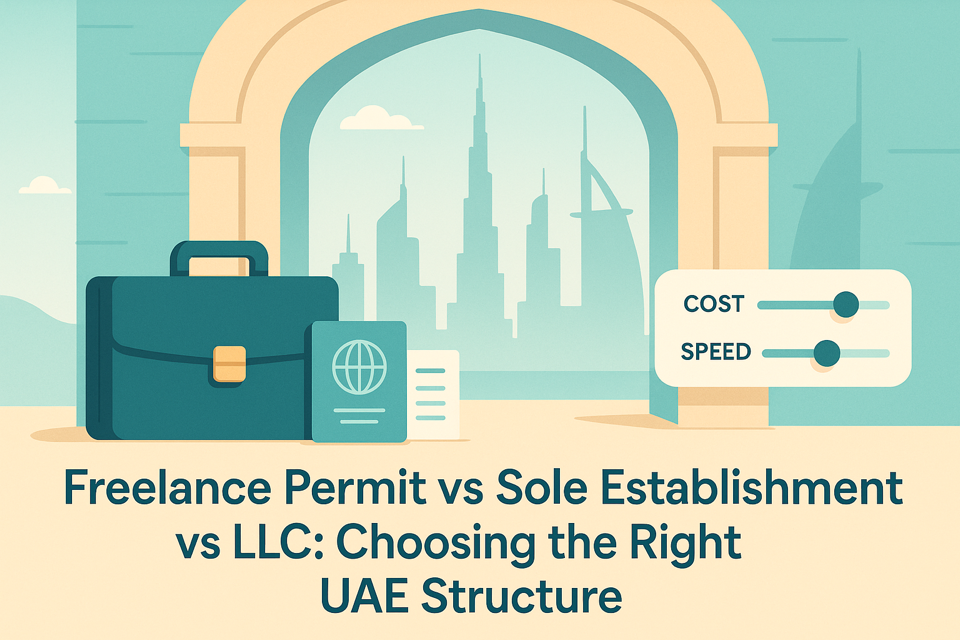
The UAE has effectively three default starting points for an individual to operate a small business in their own name: a freelance permit, a sole establishment licence, or an LLC (limited liability company). The three look interchangeable in marketing copy from setup agents but they sit on very different ground when it comes to liability, cost, visa quota, customer perception, banking access, and Corporate Tax treatment.
Choosing the wrong structure on day one is a slow tax. Each year, the gap between what you have and what would have suited you better shows up as higher fees, more friction, or unwanted personal exposure. This guide unpacks the three options so you can pick once and move on.
Quick answers
- What is a freelance permit? A licence (usually issued by a free zone) that lets one individual provide services in defined activities under their own name. Lowest setup cost, lowest formality, no separate legal personality.
- What is a sole establishment? A licensed business owned by one individual on the mainland or in a free zone. Has business identity but no separate liability: the owner is personally liable for all obligations.
- What is an LLC? A limited liability company with separate legal personality. Owners are liable only up to their capital contribution. The default vehicle for any business with risk, employees, or growth ambitions.
- Which is cheapest? A free zone freelance permit, often AED 7,500 to AED 15,000 a year all-in. Sole establishments and LLCs typically cost more in licensing, office, and renewal fees.
- Which is best for Corporate Tax? Depends. All three are within UAE Corporate Tax. The structure does not change the rate but changes whether you are taxed as a natural person or as a Resident company.
- Which gives me a UAE residence visa? Any of them, as long as the entity allows for an investor or partner visa under its sponsoring authority.
Side-by-Side at a Glance
| Feature | Freelance Permit | Sole Establishment | LLC |
|---|---|---|---|
| Legal personality | Personal, no separate entity | Trade name; owner is the legal person | Separate legal entity |
| Liability | Personal | Personal (unlimited) | Limited to capital contribution |
| Number of owners | One | One | One to several |
| Hire employees | Generally no | Yes (limited) | Yes (full quota) |
| Cost | Lowest | Mid | Highest |
| Bank account access | Hardest | Mid | Easiest |
| Customer perception (B2B) | Independent / personal | Mid | Most credible |
| Corporate Tax basis | Natural person, AED 1M threshold | Natural person OR (where licensed differently) Resident company | Resident company |
| Investor visa | Yes | Yes | Yes |
Freelance Permit
What it is
A freelance permit is issued under a free zone or, in some cases, a federal/Emirate-level scheme. It authorises an individual to perform a defined set of activities in their own name. Common issuing authorities:
- Dubai Media City / Dubai Internet City / Dubai Studio City (TECOM Group)
- Fujairah Creative City
- Ras Al Khaimah Economic Zone (RAKEZ)
- twofour54 (Abu Dhabi)
- Dubai Development Authority (DDA) for relevant activities
Strengths
- Cheapest. Annual all-in cost (licence + visa + medical + Emirates ID) typically AED 7,500 to AED 15,000.
- Fastest to set up. Often 3 to 7 working days end-to-end.
- Light governance. No share capital, no audit, no board, no annual general meeting.
- Low compliance friction. Just renewal and (where applicable) personal Corporate Tax filing.
Weaknesses
- Single-person, single-activity. You cannot easily expand into hiring or operating multiple activities.
- No separate liability shield. Your personal assets are exposed to claims arising from the work.
- Banking is the bottleneck. Many UAE banks treat freelance permit holders as marginal-risk for business accounts. Expect to be offered a personal account with reduced features and higher minimum balances.
- Customer perception: large enterprise procurement teams sometimes resist contracting with freelance permits, preferring an LLC counterparty.
- Visa quotas: typically just one investor visa. Spouse/dependent visas require the usual minimum salary thresholds.
Who it suits
- Solo creative professionals, consultants, designers, photographers, writers, marketers.
- Anyone trialling the UAE before committing to fuller infrastructure.
- Independent contractors with a small, repeating client base who do not need employees.
Sole Establishment
What it is
A licensed business owned and operated by a single individual on the mainland (issued by the Department of Economic Development of an Emirate) or, in some setups, in a free zone. The licence is in the owner’s personal name. There is no shareholder; the owner is the legal owner and the business has no separate personality.
Strengths
- Higher credibility than a freelance permit for customer-facing brands.
- Mainland reach. A mainland sole establishment can serve mainland customers without restriction (free zone freelance permits can have restrictions on mainland operating activity).
- Hire staff. Subject to the licensing authority’s rules, you can typically employ a small number of people under a sole establishment.
- Wider activity scope. Sole establishments can be licensed for broader activities than narrow freelance permits.
Weaknesses
- Unlimited personal liability. All of the owner’s personal assets are exposed to creditors of the business.
- More expensive than a freelance permit. Mainland sole establishments come with DED licensing, office requirements (or flexi-desk), and fees.
- Conversion to LLC is possible later but adds complexity. See our guide on converting a sole establishment to an LLC.
Who it suits
- Small consultancies and personal brands serving mainland UAE clients.
- Owner-operated retail and trading where the size does not yet justify a corporate vehicle.
- Service businesses that need DED licensing for their activity.
Limited Liability Company (LLC)
What it is
A separate legal entity with shareholders, directors, share capital, and registered office. Liability of the owners is limited to their capital. LLCs can be set up on the mainland (where rules now permit 100% foreign ownership in most activities) or in a free zone (e.g., DMCC, JAFZA, RAKEZ, IFZA, Meydan, ADGM/DIFC).
Strengths
- Limited liability shield. The owner’s personal assets are insulated from business obligations.
- Hire employees. Full visa quotas, payroll under WPS, and gratuity rules apply.
- Easier banking. UAE banks are far more comfortable with LLCs than with freelance permits.
- Best customer perception in B2B and enterprise procurement.
- Scalability. Add shareholders, raise capital, or sell shares without reorganising the underlying business.
- Eligible for QFZP at 0% (free zone LLC, conditions met). See our QFZP guide.
Weaknesses
- Highest setup and annual cost. Office space (real or flexi), licensing, share capital, audit (in many cases). Plan for AED 25,000 to AED 60,000+ a year all-in depending on the jurisdiction and activities.
- More compliance. Audited accounts, AGM, share register, UBO register, and Corporate Tax return.
- Slower setup. 2 to 6 weeks for licensing and bank account, depending on jurisdiction.
Who it suits
- Anyone with employees, real revenue, or material risk exposure.
- Founders planning to raise capital, hire, or scale.
- Consultancies, agencies, or service firms billing AED 1 million+ annually.
- Any business holding inventory, real estate, or material assets.
Corporate Tax: How Each Structure Is Treated
UAE Corporate Tax does not exempt any of the three forms.
- A freelance permit holder is a natural person for tax. The AED 1 million annual turnover threshold applies. Below the threshold, no Corporate Tax registration. Above, register and file as a natural person.
- A sole establishment is similar in treatment to a freelance permit if held in personal name (still a natural person), although the licensing form is different.
- An LLC is always a Resident Person from incorporation and must register for Corporate Tax regardless of revenue. The standard 9% applies above AED 375,000.
- Small Business Relief (revenue at or below AED 3 million, available through tax periods ending on or before 31 December 2026) is potentially available to all three, subject to qualifying conditions.
- VAT is independent of structure. The VAT registration threshold is AED 375,000 of taxable supplies regardless of how you are licensed.
Liability: The Single Most Underrated Factor
For day-to-day operations the difference between a sole establishment and an LLC is subtle. For a single bad event (a customer dispute, a lawsuit, an injury, a missed contract obligation), the difference is enormous.
- Freelance permit / Sole establishment: the owner is personally on the hook. A judgment debt, a successful claim, or a regulatory fine can pursue the owner’s personal bank balance, real estate (subject to UAE real estate enforcement rules), and other assets.
- LLC: the owner’s exposure is capped at the share capital, except in cases of fraud, gross negligence, or specific regulatory liabilities that pierce the corporate veil.
Any business with employees, customer-facing risk, or contractual liability above its capital should be in an LLC. Period.
Banking: The Practical Bottleneck
UAE banks have tiered their willingness to onboard small businesses by structure:
- LLC (especially mainland or DIFC/ADGM): routine onboarding, several banks compete for the relationship.
- Free zone LLC: routine, sometimes with slightly higher minimum balances.
- Sole establishment: workable but with more questions and heavier KYC.
- Freelance permit: the hardest. Many banks will offer a personal account only, or a “freelancer” account with reduced features. A handful of banks now offer dedicated freelance accounts with reasonable terms; selection matters.
If banking experience matters (high transaction volume, international transfers, treasury management), an LLC is almost always the right call.
Cost Comparison
Order-of-magnitude annual all-in costs (licence + office + visa + audit where applicable):
- Freelance permit: AED 7,500 to AED 15,000.
- Sole establishment (free zone or mainland flexi-desk): AED 15,000 to AED 30,000.
- LLC (free zone, smaller jurisdictions): AED 18,000 to AED 35,000.
- LLC (mainland or premium free zones): AED 30,000 to AED 80,000+.
- DIFC / ADGM regulated entity: materially higher again.
These exclude one-off setup fees, attestations, share capital deposit (where required), bank deposits, and operating costs.
How to Choose: A Simple Rule
A simple decision tree that gets the right answer 90% of the time:
- Will you ever have employees, hold inventory, or take on contractual liability above your savings? → LLC.
- Do you bill mainland UAE clients who insist on contracting with a UAE-licensed entity? → LLC (mainland or appropriate free zone), or in some cases a sole establishment.
- Are you a solo professional billing under AED 1 million a year, with low risk and no employees? → Freelance permit.
- Are you a solo professional but the freelance permit activity list does not cover what you do? → Sole establishment.
- Are you a small operating business with one owner and a small team? → LLC (smaller free zone is usually the cheapest LLC route).
Common Mistakes
- Using a freelance permit for a business with employees or material risk. Often done to save AED 20,000 a year; ends up costing far more on a single dispute.
- Setting up an LLC before testing the business. When the activity is unproven and revenue is uncertain, a freelance permit for the first 6 to 12 months is a sensible bridge.
- Choosing the cheapest free zone without checking activity scope. Each free zone has its own permitted activity list. The cheapest option may not licence what you actually do.
- Forgetting bank account due diligence. Your bank choice depends on your structure and your business model. Pick the structure with banking in mind.
- Ignoring Corporate Tax implications. A freelance permit at AED 1.4 million revenue still incurs Corporate Tax registration and filing as a natural person. Plan for it from day one.
- Mainland vs free zone confusion. Some activities cannot be licensed in some free zones. Some free zones cannot serve mainland customers without a service agent or branch. Map this against where your customers are. See our mainland vs free zone guide.
Frequently Asked Questions
Can I convert a freelance permit to an LLC later? You generally cannot convert directly. You set up a new LLC and migrate the activity, the contracts, and (in time) the bank account into it. The freelance permit is then either kept dormant or cancelled.
Is a UAE freelance permit valid in mainland UAE? A free zone freelance permit allows you to provide services from within the free zone. Performing services for mainland clients usually requires either operating from your free zone office or, for some activities, a mainland branch or specific permission. Restrictions vary by free zone and by activity.
Does a sole establishment offer any liability protection? No. The owner is personally liable for all business obligations. This is the single most important reason to consider an LLC even at small scale.
Can a freelance permit holder hire employees? Generally no. Freelance permits are issued on the basis that the individual is the sole performer of the activity. Hiring requires a different structure (sole establishment with relevant authorisations or, more commonly, an LLC).
Which structure is best for a startup? An LLC (free zone or mainland) is almost always the right choice for a startup with co-founders, IP, future employees, or external investors. Foundational documents (shareholders agreement, IP assignments, vesting) work cleanly within an LLC.
Do I pay UAE Corporate Tax differently as a freelancer vs LLC? The rate and structure are similar (0% to AED 375,000, then 9%), but a freelancer is taxed under the natural-person framework with the AED 1 million revenue threshold for registration. An LLC is a Resident Person from day one and must register from incorporation.
How quickly can I set up each structure? A freelance permit can be set up in 3 to 7 working days. A sole establishment typically 5 to 15 working days. An LLC 2 to 6 weeks (depending on jurisdiction and bank account). Premium financial free zones (DIFC, ADGM) take longer.
How Success Business Advisors can help
We assess your business model, liability profile, and growth plan, then recommend the right vehicle and the right jurisdiction for you in one session. Where you already have a freelance permit or sole establishment, we plan and execute the migration to an LLC at the right time. Book a consultation and we will lay out your options in 30 minutes.
Ready to take the next step?
Schedule an Appointment WHO WE WORK WITH