UAE Customs Duty and Import-Export Compliance: HS Codes, the 5% Rule, and What Actually Trips Up Importers
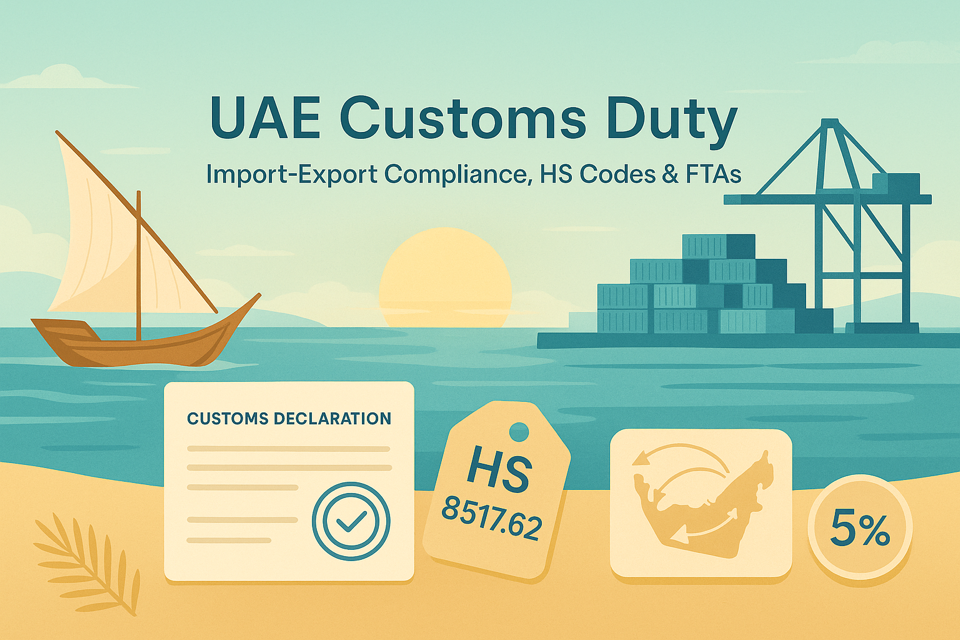
The UAE is one of the world’s busiest trade hubs, and the rules that govern goods crossing its borders are often the second-biggest cost driver after the goods themselves. Yet customs is a topic most SMEs leave to their freight forwarder until the day a shipment is held, a duty assessment is challenged, or an audit surfaces years of mis-classified imports.
The mechanics are knowable. The UAE applies the GCC Common Customs Tariff at a base rate of 5% on most goods, with carve-outs and zero-rated categories on top. HS code classification is what determines the rate. GCC origin allows goods produced within the customs union to move freely. Free Trade Agreements with countries like India (CEPA), Indonesia, Israel, Turkey, and others can eliminate or reduce duty on specific goods. Free zones operate under their own customs treatment that defers or avoids duty entirely until goods enter the UAE mainland market.
This guide explains how the system fits together, where importers and exporters consistently overpay or get caught, and how to set up a customs operation that runs cleanly.
Quick answers
- What is the standard UAE import duty? 5% of the customs value for most goods, under the GCC Common Customs Tariff. Some categories are duty-free (essential foods, books) and some are higher (alcohol, tobacco).
- What is an HS code? A Harmonized System code identifying the goods at six digits internationally and extended by the UAE/GCC to ten digits. The HS code drives the duty rate, restrictions, and any preferential treatment.
- What is GCC origin? Goods produced in any GCC member state with sufficient local content can circulate within the bloc free of customs duty.
- Can I avoid duty by using a free zone? Goods stored in a UAE free zone are not subject to customs duty until they enter the UAE mainland or another GCC market. Re-export from the free zone is duty-free.
- Does the UAE have free trade agreements? Yes, including the CEPA with India, agreements with Indonesia, Israel, Türkiye, and ongoing negotiations with several others.
- Where do most importers overpay? Wrong HS code, wrong customs valuation method, missed FTA eligibility, missed duty drawback opportunities.
The Federal-Local Customs Architecture
UAE customs has a two-tier structure:
- Federal Customs Authority (FCA) sets policy, manages international agreements, and oversees the application of the GCC Common Customs Tariff.
- Emirate-level customs administrations (Dubai Customs, Abu Dhabi Customs, Sharjah Customs, etc.) operate the day-to-day clearance, collect the duty, and run the local processes.
Most importers interact with their Emirate’s customs administration. Dubai Customs’ Mirsal 2 system and Abu Dhabi Customs’ platform are the operational interfaces. Federal coordination ensures consistency on tariff and origin rules.
The GCC Common Customs Tariff: 5% Default
The GCC Common Customs Tariff applies a base rate of 5% on the CIF value (Cost + Insurance + Freight) of most imported goods. Two categories deviate:
- Duty-free categories: essential foods (rice, sugar, meat, etc.), printed books, certain pharmaceuticals, certain capital equipment, charitable goods.
- Higher rates: alcohol (typically 50%) and tobacco (typically 100%).
Specific goods have specific exceptions or surcharges; the published GCC tariff schedule is the authoritative source.
Customs value: CIF and what is included
Customs value usually includes:
- Invoice value of the goods.
- International freight to the UAE port.
- Insurance.
- Loading and unloading at the foreign port.
- Royalties, licence fees, and selling commissions where they are a condition of sale.
It usually excludes:
- Inland transport within the UAE after customs clearance.
- Buying commissions paid to a buyer’s agent.
- Costs of duties and taxes payable in the UAE.
Misstating the customs value is the most common source of disputes and reassessments. Get the customs value right at first declaration; correcting it later is painful.
HS Code Classification
The Harmonized System is a global classification of goods, agreed by the World Customs Organization. The first six digits are international; countries extend with their own digits for finer detail. The UAE/GCC uses ten-digit HS codes.
Why the HS code matters
- It determines the duty rate.
- It determines whether the goods are restricted, controlled, or prohibited.
- It determines FTA eligibility (preferential rates apply only to goods covered by the FTA’s product list).
- It determines anti-dumping or countervailing duties where applicable.
- It determines technical standards and certificate-of-conformity requirements (e.g., ESMA, EAS).
The reality on the ground
Many SMEs delegate HS classification to their freight forwarder, who often picks the closest plausible code rather than the most accurate one. Two consequences:
- Overpaying duty because a category at 5% was used when a duty-free category applied.
- Underpaying duty at the cost of a back-assessment later (with penalties and interest).
A periodic HS audit, especially for high-volume imports, almost always finds opportunities to refile or correct classification.
Rules of Origin: GCC and FTA
GCC origin
The GCC operates as a customs union. Goods produced in any of the six GCC states (UAE, Saudi Arabia, Kuwait, Qatar, Oman, Bahrain) with sufficient local content (typically a minimum value-added threshold and substantial transformation rules) qualify for GCC origin. They can move between GCC states without customs duty.
GCC origin requires a Certificate of Origin issued by the producing country’s authorised body (in the UAE, typically the relevant Emirate’s chamber of commerce).
Bilateral and pluri-lateral FTAs
The UAE has signed and continues to negotiate Comprehensive Economic Partnership Agreements (CEPAs) and FTAs. Notable agreements:
- CEPA with India (2022): broad coverage of goods and services, with phased duty reductions on a wide list of products.
- CEPA with Indonesia (2023): similar structure.
- CEPA with Israel (2022).
- CEPA with Türkiye (2023).
- Other negotiations ongoing with several economies.
For SME importers, the question is always: do my goods fall within the FTA product list, and do they qualify under the FTA’s rules of origin? Where the answer is yes, savings can be substantial. Many importers simply pay the standard 5% because they have not run the eligibility check.
Free Zones and Customs
A UAE free zone is, for customs purposes, a bonded area outside the customs territory of the UAE. Goods imported into a free zone are not subject to customs duty until they cross into the UAE mainland or another GCC state. Goods that are stored, processed, transformed, or re-exported from the free zone never become liable for UAE/GCC customs duty.
This is what makes free zones a workhorse for trading, distribution, and re-export operations, regional hubs that import from one country, hold inventory in a UAE free zone, and ship to multiple destination markets without intermediate duty leakage.
For mainland operators, free zones can also be used to defer duty: hold inventory in the free zone, declare and clear into the mainland only when the goods are sold. The cash-flow saving is real but requires setting up the appropriate licensing and inventory tracking.
Documentation: What a Clean Import Looks Like
A clean UAE import declaration includes:
- Commercial invoice (legalised in some cases for high-value or government-related shipments).
- Packing list.
- Bill of lading or air waybill.
- Certificate of origin (especially for FTA or GCC origin claims).
- Insurance certificate.
- Specific authority approvals for restricted goods (e.g., MoHAP for medicines, ESMA for certain consumer products, MoCCAE for food).
- Customs declaration filed through the Emirate-level system.
For exports:
- Export declaration.
- Commercial invoice.
- Certificate of origin issued by the chamber of commerce.
- Bill of lading or air waybill.
- Specific export approvals for restricted goods.
Authorised Economic Operator (AEO)
UAE customs runs an AEO programme, granting trusted-trader status to importers and exporters that meet defined compliance standards. AEO benefits include:
- Faster clearance with lower physical inspection rates.
- Reduced bank guarantees and bonds.
- Single-window facilitation with Emirate-level customs.
- Mutual recognition with AEO programmes in selected countries.
For SMEs at sufficient scale (typically AED 50 million+ in annual import value or material export operations), AEO status materially improves operational throughput. Application is voluntary and requires a compliance and security audit.
Anti-Dumping and Countervailing Duties
Where specific products from specific countries are determined to be dumped (sold below normal value) or subsidised by the exporting government, the UAE/GCC may impose anti-dumping or countervailing duties on top of the standard 5%. These are typically applied to a defined HS code from a defined country for a defined period.
Importers in affected categories should monitor official notices and consider:
- Sourcing from alternative origins.
- Restructuring supply chains to bypass the dumped origin.
- Where eligible, applying for refund or exemption under specific programmes.
Where Most Importers Overpay
- Wrong HS code. Routine, costly, and reversible with refile.
- Wrong customs valuation method. Especially when related-party purchases are involved (transfer pricing methodology must be defensible to customs as well as to the FTA).
- Missed FTA eligibility. CEPA-eligible goods cleared at the standard 5% because no certificate of origin was claimed.
- Missed duty drawback / re-export refunds. Goods cleared into the UAE mainland and then re-exported can attract a refund in defined circumstances.
- Incorrect Incoterms classification of CIF vs FOB cost components.
- No use of free zone deferral where it would otherwise apply.
- Forgetting transitional provisions when product specifications, materials, or supplier countries change.
A periodic customs audit is almost always cash-positive for any importer above a few million dirhams of annual import value.
Customs Interaction With VAT and Corporate Tax
- Import VAT at 5% applies on the customs value plus duty plus a few specific additions. Reverse charge mechanisms reduce cash-flow impact for VAT-registered importers; planning the VAT mechanics at the same time as customs is important.
- Excise tax can apply to specific categories on top of customs duty (see our UAE excise tax guide).
- Corporate Tax: customs duties are typically deductible business expenses for Corporate Tax purposes. Customs declarations are part of the contemporaneous documentation that supports the Corporate Tax position.
Common Mistakes
- Treating customs as a freight-forwarder problem. The forwarder is your declarant, not your tariff strategist.
- No HS code library. Companies that import the same products repeatedly should maintain an internal HS library reviewed annually.
- No FTA tracking. New CEPAs come into force regularly; without monitoring, eligible savings go unclaimed.
- Ignoring customs valuation rules for related parties. Customs has its own valuation methodology that is not always identical to the transfer pricing policy.
- No AEO consideration. SMEs that grow into significant import volumes often run for years without AEO status, missing real operational savings.
- Mixing free zone and mainland operations without ringfencing inventory. Customs and tax both depend on knowing which goods are in which regime.
Frequently Asked Questions
What is the standard UAE customs duty rate? 5% of the customs value for most imported goods, under the GCC Common Customs Tariff. Some categories are duty-free (essential foods, printed books, specific exceptions) and a few are higher (alcohol, tobacco).
How do I claim the FTA preferential rate? By presenting a valid Certificate of Origin issued by the exporting country’s authorised body, ensuring the HS code falls within the FTA’s product list, and meeting the FTA’s specific rules of origin.
Are free zones really exempt from customs duty? Goods stored in a UAE free zone are not subject to UAE/GCC customs duty until they enter the UAE mainland or another GCC state. Re-export from the free zone to non-GCC markets is duty-free.
How can I challenge a customs valuation? Through the Emirate customs administration’s review process, with documented support for the alternative valuation method (transaction value, identical goods, similar goods, etc., per the WTO Customs Valuation Agreement). Professional advice is usually warranted for material amounts.
What is an Authorised Economic Operator? A trusted-trader status granted by UAE customs that provides faster clearance, reduced inspection, lower bank guarantee requirements, and mutual recognition with AEO programmes in selected partner countries.
Do I pay VAT on imports as well as customs duty? Yes. Import VAT at 5% applies on customs value plus duty plus certain additions. VAT-registered importers can typically use reverse charge mechanisms to neutralise the cash-flow impact.
Can I get a refund for duty paid on goods I later re-exported? In defined circumstances, yes. Duty drawback rules apply where goods cleared into the UAE mainland are subsequently re-exported. The conditions and documentation are specific; engage customs advice for material amounts.
How Success Business Advisors can help
We run customs and tariff audits for UAE importers and exporters, identify HS code corrections and FTA eligibility, structure free-zone-and-mainland flows for duty deferral, and support AEO applications. We integrate customs strategy with VAT, excise, and Corporate Tax planning so the savings land cleanly. Book a consultation and we will pressure-test your customs position in 30 minutes.
Ready to take the next step?
Schedule an Appointment WHO WE WORK WITH