Transfer Pricing Rules in the UAE: What SMEs and Multinationals Need to Know
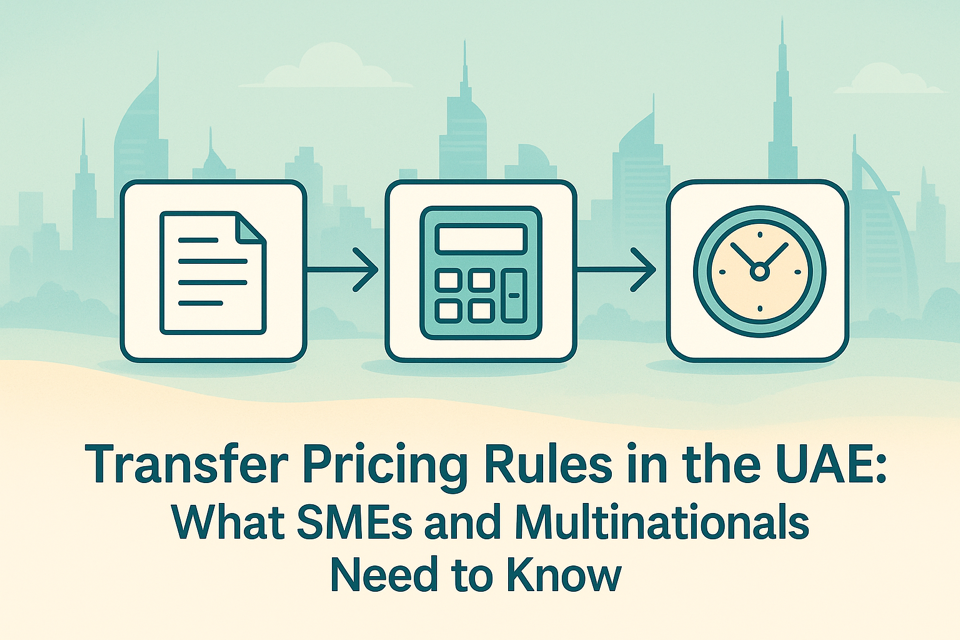
With the introduction of UAE Corporate Tax under Federal Decree-Law No. 47 of 2022, the UAE formally adopted transfer pricing (TP) rules aligned with the OECD’s internationally recognised guidelines. These rules apply not just to large multinationals but, in many circumstances, to UAE SMEs engaged in transactions with related parties.
If your business buys from, sells to, lends to, or receives services from a connected company or individual, transfer pricing is no longer something you can ignore.
What is Transfer Pricing?
Transfer pricing refers to the prices set for transactions between related parties — companies or individuals under common ownership or control. Because these parties are not dealing at arm’s length (i.e., as independent parties in a free market), there is a risk that prices can be manipulated to shift profits to lower-tax jurisdictions.
The UAE’s response is to require that all related-party transactions be priced as if they were conducted between independent parties — the arm’s length principle.
Who Are “Related Parties” Under UAE Law?
Under the Corporate Tax Law, related parties include:
- A natural person and a juridical person (company) if the person holds 50% or more of the ownership or voting rights.
- Two or more juridical persons where the same party (directly or indirectly) holds 50% or more in each.
- Partners in an unincorporated partnership.
- Any person who has control over another through other means (board representation, contractual rights, etc.).
Common Related-Party Transactions Subject to TP Rules
- Intercompany loans: Interest rates between group entities must reflect market rates.
- Management fees: Charges for head-office services, IT, HR, or legal support shared across group companies.
- Sale or purchase of goods: Pricing of inventory or raw materials transferred between related entities.
- Royalties and IP licensing: Charges for the use of trademarks, patents, or software owned by a related party.
- Shared services: Cost-sharing arrangements between group companies for joint activities.
Transfer Pricing Documentation Requirements
UAE businesses must prepare and maintain documentation demonstrating compliance with the arm’s length principle. The requirements vary by size:
Mandatory Transfer Pricing Disclosure Form
All taxable persons with related-party transactions must submit a Transfer Pricing Disclosure Form as part of their Corporate Tax Return, regardless of size.
Master File and Local File
Businesses that meet either of the following thresholds must maintain a Master File and Local File:
- Revenue of AED 200 million or more in the relevant tax period, or
- Part of a Multinational Enterprise (MNE) group with consolidated global revenues of AED 3.15 billion or more.
The Master File provides an overview of the group’s global business, value chain, and transfer pricing policies. The Local File provides transaction-specific information and the economic analysis supporting arm’s length pricing for each related-party transaction.
Country-by-Country Report (CbCR)
MNE groups with consolidated global revenues of AED 3.15 billion or more must also file a Country-by-Country Report (discussed in a separate guide).
Choosing a Transfer Pricing Method
The OECD — and, by extension, the UAE — prescribes five standard TP methods. The most commonly used are:
- Comparable Uncontrolled Price (CUP): Compares the price charged in a related-party transaction to the price charged in a comparable transaction between independent parties.
- Cost Plus Method: Adds an appropriate markup to the supplier’s costs.
- Resale Price Method: Works backwards from the price at which a product is resold to an independent party.
- Transactional Net Margin Method (TNMM): Compares the net profit margin of the related-party transaction to net margins earned in comparable uncontrolled transactions.
- Profit Split Method: Splits the combined profits of a transaction between related parties based on each entity’s relative contribution.
The selection of the most appropriate method depends on the nature of the transaction and the availability of comparable data.
Penalties for Non-Compliance
The Federal Tax Authority (FTA) can impose penalties for failure to maintain adequate transfer pricing documentation or for transactions that are not at arm’s length. These can include adjustments to taxable income, resulting in additional Corporate Tax liabilities, plus late payment penalties and interest.
What UAE SMEs Should Do Now
Even smaller businesses with related-party transactions should:
- Map all related-party transactions — identify every intercompany flow of goods, services, funds, or IP.
- Document the commercial rationale for each transaction.
- Benchmark prices using publicly available databases or comparable market data.
- Prepare the Transfer Pricing Disclosure Form as part of the annual Corporate Tax Return.
- Maintain records for a minimum of seven years.
How Success Business Advisors Can Help
Transfer pricing compliance can be complex, particularly for businesses with multi-jurisdictional structures. At Success Business Advisors, we help you:
- Identify and document all related-party transactions.
- Select and apply the most appropriate TP methodology.
- Prepare Master Files, Local Files, and Disclosure Forms to FTA standards.
- Defend your TP positions in the event of an FTA audit.
Don’t leave your intercompany pricing to chance. Contact Success Business Advisors to ensure your transfer pricing arrangements are robust, documented, and fully compliant with UAE law.
Ready to take the next step?
Schedule an Appointment WHO WE WORK WITH