RAK vs. Dubai vs. Abu Dhabi: Choosing the Right Emirate for Your Business
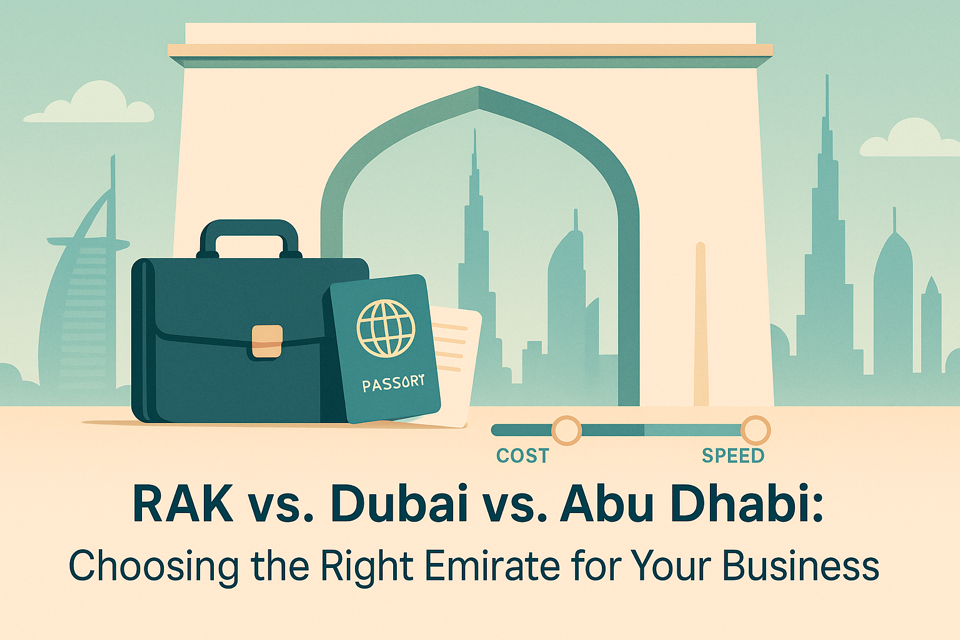
When setting up a business in the UAE, most entrepreneurs focus on the question of Mainland versus Free Zone — but there is an equally important decision that often gets overlooked: which emirate?
The UAE comprises seven emirates, each with its own regulatory authorities, free zones, cost structures, and strategic advantages. While Sharjah, Fujairah, Ajman, and Umm Al Quwain all have their niches, the three most popular destinations for business formation are Ras Al Khaimah (RAK), Dubai, and Abu Dhabi.
This guide compares each emirate across the dimensions that matter most to business owners.
Quick answers
- Cheapest setup: RAK (RAKEZ), by a meaningful margin.
- Strongest brand and ecosystem: Dubai, particularly for trading, services, and consumer-facing businesses.
- Best for government contracts: Abu Dhabi, given the federal seat and sovereign wealth ecosystem.
- Best for financial services: Dubai (DIFC) and Abu Dhabi (ADGM), depending on focus.
- Best for industrial and manufacturing: RAK (Saqr Port) and Abu Dhabi (KIZAD).
- 100% foreign ownership: Available in all three emirates, free zone or mainland (since June 2021 Federal Decree-Law 26 of 2020).
Ras Al Khaimah (RAK)
Often referred to as the UAE’s most cost-effective business destination, RAK has grown significantly as a location for company formation over the past decade. The emirate is home to the Ras Al Khaimah Economic Zone (RAKEZ), one of the most flexible and competitively priced free zones in the country.
Key Advantages of RAK
- Lower setup and licence costs: Company formation, trade licence fees, and annual renewals in RAKEZ are significantly cheaper than equivalent costs in Dubai or Abu Dhabi. This makes RAK particularly attractive for startups, SMEs, and cost-conscious entrepreneurs.
- Flexible licence types: RAKEZ offers business, industrial, educational, and media licences, catering to a wide range of activities.
- 100% foreign ownership: Like all UAE free zones, RAKEZ offers full foreign ownership with no local sponsor requirement.
- Industrial and manufacturing hub: RAK has excellent port access (Saqr Port, one of the region’s largest bulk cargo ports) and affordable industrial land, making it ideal for manufacturing, logistics, and heavy industry.
- Tax Treaty TRC eligibility: The UAE has an extensive network of Double Tax Avoidance Agreements (DTAAs), and RAK-based entities can access these treaties, subject to meeting UAE tax residency requirements.
- Proximity to Dubai: RAK is approximately 45–60 minutes from Dubai, making it practical for businesses that need access to Dubai’s market while keeping overheads low.
Ideal For
Cost-conscious SMEs, international holding companies, manufacturing and industrial businesses, e-commerce, and consulting firms primarily serving international clients.
Dubai
Dubai is the UAE’s commercial and tourism capital and the region’s most globally recognised business hub. It offers unparalleled infrastructure, connectivity, and a concentration of multinational corporations, investors, and skilled talent.
Key Advantages of Dubai
- Unmatched brand recognition: A Dubai address carries significant weight with international clients, investors, and financial institutions.
- Diverse and specialised free zones: Dubai is home to over 30 free zones, each tailored to specific industries (see our deeper comparison of DIFC vs ADGM):
- DIFC (Dubai International Financial Centre): Common law jurisdiction for financial services, fund management, and fintech.
- DMCC (Dubai Multi Commodities Centre): The world’s largest free zone for commodities trading.
- Dubai Internet City (DIC) / Dubai Silicon Oasis: Technology, IT, and innovation firms.
- Dubai Media City: Media, publishing, and creative industries.
- Dubai South: Aviation, logistics, and e-commerce near Al Maktoum International Airport.
- Access to world-class talent: Dubai’s expatriate population and recruitment ecosystem provide access to professionals from across the globe.
- Superior logistics: Dubai International Airport (the world’s busiest for international passengers) and Jebel Ali Port (the largest in the Middle East) make Dubai the region’s premier logistics hub.
Key Considerations
Dubai is the most expensive of the three emirates for company formation, licensing, and commercial real estate. Businesses must carefully model setup and operational costs before committing, and decide between mainland or free zone setup before choosing a jurisdiction.
Ideal For
Financial services, trading companies, technology firms, retail, hospitality, media and marketing, professional services firms serving the local UAE market, and any business that benefits from a globally recognised business address.
Abu Dhabi
Abu Dhabi is the UAE’s capital and wealthiest emirate, home to the country’s vast oil revenues, sovereign wealth funds, and federal government institutions. While historically less focused on private enterprise than Dubai, Abu Dhabi has made significant strides in diversifying its economy and attracting international businesses.
Key Advantages of Abu Dhabi
- Largest government and institutional client base: Abu Dhabi is the seat of federal government and hosts a vast network of government departments, state-owned enterprises, and sovereign wealth funds (ADIA, Mubadala). Businesses targeting government contracts will find Abu Dhabi indispensable.
- ADGM (Abu Dhabi Global Market): Located on Al Maryah Island, ADGM is a world-class international financial centre operating under English common law, regulated by the FSRA. It directly competes with DIFC for financial services firms and is growing rapidly.
- Khalifa Industrial Zone Abu Dhabi (KIZAD): A large-scale industrial and logistics free zone connected to Khalifa Port, ideal for heavy industry and manufacturing.
- twofour54: Abu Dhabi’s dedicated media and creative industries free zone.
- Significant government investment in infrastructure: Abu Dhabi continues to invest heavily in its economy through Vision 2030, creating new opportunities across healthcare, tourism, renewables, and technology.
Key Considerations
Abu Dhabi’s private sector ecosystem is less mature than Dubai’s, and the talent pool, while growing, is somewhat smaller. Costs are broadly comparable to Dubai for premium business locations, though the overall commercial real estate market is generally more affordable.
Ideal For
Financial services firms (particularly those seeking an ADGM licence), businesses targeting UAE government and semi-government contracts, industrial and manufacturing companies, and those in sectors aligned with Abu Dhabi’s Vision 2030 priorities (renewables, healthcare, tourism).
Quick Comparison
| Factor | RAK | Dubai | Abu Dhabi |
|---|---|---|---|
| Setup Cost | Low | High | Medium–High |
| Brand Recognition | Growing | Very High | High |
| Government Contracts | Limited | Good | Excellent |
| Financial Services | Limited | DIFC | ADGM |
| Industrial/Manufacturing | Excellent | Good | Good (KIZAD) |
| International Connectivity | Good (via Dubai) | Excellent | Very Good |
| Cost of Living / Ops | Lowest | Highest | Medium–High |
Which Should You Choose?
- Choose RAK if your priority is cost-efficiency, you serve international clients primarily, or you need an industrial or manufacturing base.
- Choose Dubai if you need the strongest brand credibility, a specialised free zone (DIFC, DMCC, etc.), or direct access to a large consumer or corporate market.
- Choose Abu Dhabi if your business model depends on government or institutional clients, or you are a financial services firm seeking an ADGM licence.
Whichever emirate you choose, work through our UAE business setup and compliance checklist before signing the licence application.
Frequently Asked Questions
Which emirate is cheapest for setting up a company? RAK, via RAKEZ. Setup, trade licence, and renewal fees are meaningfully lower than equivalent costs in Dubai or Abu Dhabi.
Can I operate across the UAE if I am licensed in RAK? Yes, but the same mainland vs free zone rules apply. A free zone licence in any emirate restricts direct mainland trading without a distributor or branch.
Which emirate is best for financial services firms? Dubai (DIFC) for the largest ecosystem and brand recognition; Abu Dhabi (ADGM) for digital assets, ESG, family offices, and proximity to sovereign wealth.
Is 100% foreign ownership available in all three emirates? Yes. Free zones have always permitted it, and since June 2021 most mainland commercial and industrial activities allow 100% foreign ownership across all emirates.
Where should I set up if I sell to UAE government clients? Abu Dhabi, in most cases. The federal seat and the bulk of sovereign and government procurement sit in Abu Dhabi.
Do I have to live in the emirate where my company is licensed? No. Many entrepreneurs license in RAK or a free zone for cost reasons while living in Dubai. Visa eligibility is tied to the licence rather than the residence emirate.
How does the choice of emirate affect Corporate Tax? The 9% headline rate applies UAE-wide. The free zone 0% rate on Qualifying Income is available in qualifying free zones in any emirate, subject to the QFZP conditions.
How Success Business Advisors can help
Based in Ras Al Khaimah, we have deep expertise in RAKEZ and the broader UAE setup landscape and will compare all three emirates against your specific model. Schedule a call and we will recommend the right jurisdiction in 30 minutes.
Ready to take the next step?
Schedule an Appointment WHO WE WORK WITH