WPS, Payroll Compliance, and the DEWS Scheme: A Complete Guide for UAE Employers
Getting people paid sounds simple. In the UAE, the mechanics behind it carry real regulatory weight. The Wage Protection System (WPS), Savings and Investment Fund (SIF) contributions, end-of-service gratuity, and newer alternatives like the DIFC Employee Workplace Savings (DEWS) scheme each come with their own rules, deadlines, and penalties. Miss one and MoHRE or DIFC Authority will let you know.
This guide walks UAE employers through every payroll compliance obligation that matters in 2026.
Quick answers
- What is WPS? A government-mandated electronic salary transfer system that ensures employees are paid on time, in full, and through approved channels.
- Who must use WPS? All private-sector employers registered with MoHRE. Free zone employers follow their zone’s equivalent rules.
- What is SIF? A social insurance contribution required for UAE and GCC national employees. Expatriate employees are not covered.
- What is DEWS? A defined-contribution savings plan that replaces end-of-service gratuity for DIFC-based employees, managed through approved investment providers.
- What are the penalties? Late WPS payments can trigger work permit freezes, fines, and referral to MoHRE’s labour dispute system. Repeated non-compliance can lead to licence suspension.
- Does payroll affect Corporate Tax? Yes. Salaries, allowances, and gratuity accruals are generally fully deductible expenses under UAE Corporate Tax, but only if properly documented and paid through compliant channels.
The Wage Protection System (WPS)
What it is
WPS is an electronic salary transfer system introduced by the UAE Ministry of Human Resources and Emiratisation (MoHRE). It requires employers to pay wages through banks, exchange houses, or approved financial institutions so that MoHRE can verify that employees are receiving their contractual pay, on time.
WPS is not optional. It applies to all private-sector employers operating under MoHRE labour cards.
How it works
- The employer opens a payroll account with an approved bank or exchange house (known as an “agent”).
- Each month, the employer uploads a Salary Information File (SIF) to the WPS agent. This file contains the employee’s labour card number, basic salary, allowances, deductions, and net pay.
- The WPS agent transfers the funds to employee accounts and reports the data to MoHRE.
- MoHRE matches the payment data against the employment contracts on file.
Deadlines
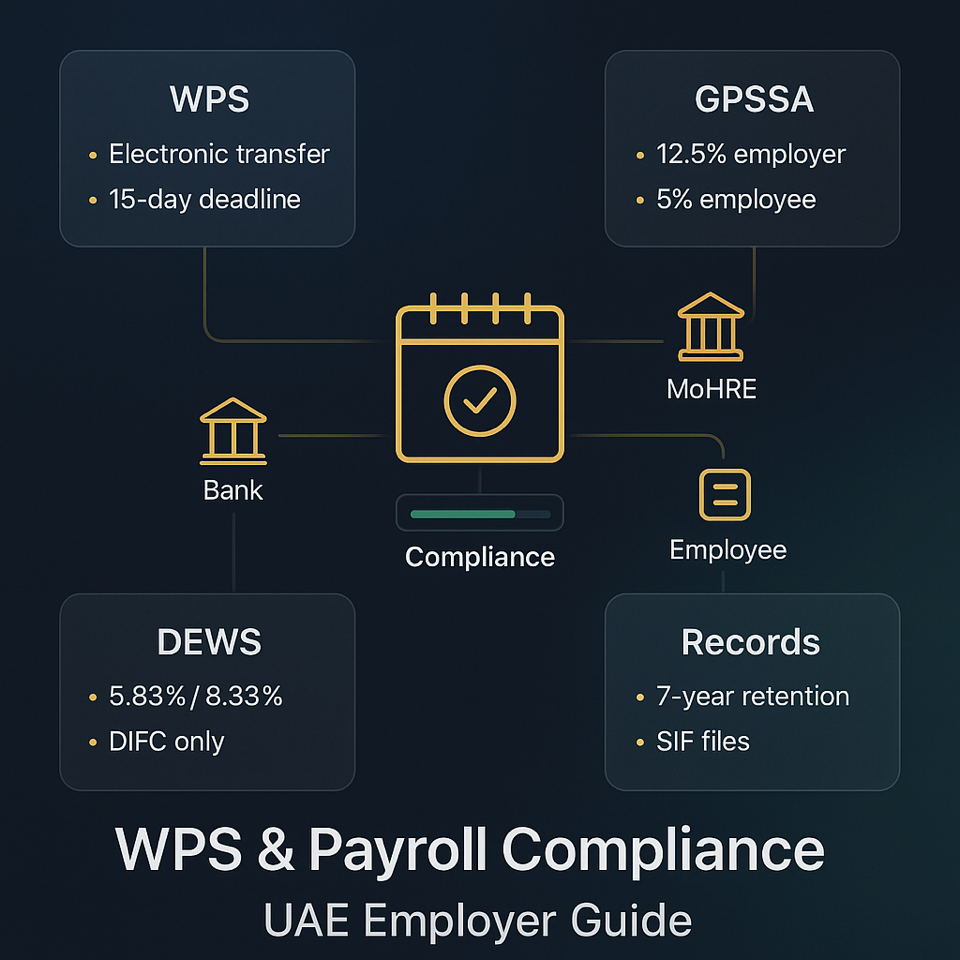
Wages must be paid within 15 days of the due date specified in the employment contract (usually the end of the calendar month). If MoHRE detects that wages are overdue by more than 15 days, it triggers an automatic alert. After 30 days, enforcement action begins.
Free zone employers
Most free zones operate their own salary protection mechanisms. DMCC, JAFZA, DAFZA, and others have WPS-equivalent requirements that mandate electronic salary transfers. The mechanics vary by zone, but the principle is the same: prove you paid your people, on time, through a tracked channel.
Common WPS mistakes
- Mismatch between contract and SIF: If the salary in the WPS file does not match the MoHRE contract, the system flags it. This often happens after a promotion or salary increase where the employer updates payroll but forgets to amend the labour contract.
- Splitting payments off-system: Paying part of the salary in cash outside WPS is a violation, even if the employee agrees. MoHRE treats the WPS amount as the total obligation.
- Late uploads: Even a few days late on the SIF upload can trigger alerts and delay new work permit applications.
Social Insurance Contributions
UAE nationals (GPSSA)
Employers of UAE national staff must contribute to the General Pension and Social Security Authority (GPSSA). The contribution rates are:
- Employer: 12.5% of the employee’s gross salary (basic salary plus allowances as defined by the GPSSA).
- Employee: 5% of gross salary (deducted from pay).
- Government: 2.5% (contributed by the federal government).
- Total: 20% of the defined contributory salary.
Contributions are due monthly, and late payment attracts penalties.
GCC nationals
GCC nationals employed in the UAE may be covered under bilateral social security agreements between the UAE and their home country. Employers should verify the applicable contribution requirements based on the employee’s nationality and the relevant inter-state agreement.
Expatriate employees
There is no mandatory social insurance for expatriate employees in the UAE (outside of DIFC and ADGM, where savings schemes apply). Expatriate employees are instead entitled to end-of-service gratuity upon termination of employment, which acts as the primary statutory savings mechanism.
End-of-Service Gratuity
Every employer in the UAE must pay end-of-service gratuity to employees who have completed at least one year of continuous service. The calculation depends on the employee’s length of service and whether they resigned or were terminated.
For the detailed calculation formulas, payment deadlines, and accounting treatment, see our dedicated guide on end-of-service gratuity in the UAE.
From a payroll compliance perspective, the key points are:
- Accrual is mandatory: Even though gratuity is paid at termination, it should be accrued monthly in your books. The FTA expects to see this as a provision on your balance sheet.
- It is deductible: Gratuity provisions, when properly accrued, are a deductible expense for Corporate Tax purposes.
- Basic salary only: Gratuity is calculated on basic salary, not the total package. Housing, transport, and other allowances are excluded unless the contract specifies otherwise.
DEWS: The DIFC Employee Workplace Savings Scheme
What is DEWS?
DEWS is a defined-contribution savings plan that replaced the traditional end-of-service gratuity for employees based in the Dubai International Financial Centre (DIFC) from 1 February 2020. Instead of accruing a lump-sum liability, employers contribute monthly to an externally managed fund.
If you are deciding between DIFC and ADGM for your financial services setup, the savings scheme is one of the practical differences worth factoring in.
How it works
- The employer registers with an approved DEWS provider (currently Zurich International Life and Equiti Financial Services are among the main providers).
- Each month, the employer contributes a percentage of the employee’s basic salary:
- 5.83% for employees with less than 5 years of service (equivalent to 21 days’ basic salary per year).
- 8.33% for employees with 5 or more years of service (equivalent to 30 days’ basic salary per year).
- Contributions are invested in one of several risk-rated funds chosen by the employee (or a default fund if they make no selection).
- When the employee leaves, they receive the accumulated contributions plus or minus investment returns.
Voluntary contributions
Employees can make additional voluntary contributions of up to 100% of their monthly salary, which are invested in the same fund structure. This makes DEWS function partly as a workplace pension, not just a gratuity replacement.
Key compliance points
- Contributions must be made within 15 days of each month-end.
- Late contributions attract penalties from the DIFC Authority.
- The employer must register all eligible employees within 20 days of their start date.
- DEWS applies to all DIFC-based employees regardless of nationality.
ADGM Savings Scheme
ADGM does not use DEWS but has signalled its own workplace savings framework. As of early 2026, ADGM employers still follow the traditional end-of-service gratuity model, though an equivalent savings scheme is expected. Employers in ADGM should monitor the ADGM Employment Regulations for updates.
Payroll and UAE Corporate Tax
Salaries, wages, and related employment costs are among the largest expense lines for most businesses, and their treatment under UAE Corporate Tax matters.
- Fully deductible: Salaries, wages, bonuses, commissions, housing allowances, transport allowances, and other contractual employee benefits are fully deductible if incurred for business purposes and paid through compliant channels.
- Gratuity accruals: End-of-service provisions are deductible when properly accrued under IFRS (or another approved standard).
- DEWS contributions: Employer contributions to DEWS are treated as an employment expense and are fully deductible.
- GPSSA contributions: Employer social insurance contributions for UAE nationals are fully deductible.
- Owner salaries: If a business owner draws a salary, it must be at arm’s length to be deductible. Overpayments to connected persons are subject to the transfer pricing rules.
Payroll Records and Retention
Under UAE labour law and Corporate Tax regulations, employers should retain:
- Employment contracts and amendments.
- Monthly WPS/SIF records.
- Payslips and salary registers.
- GPSSA contribution records.
- DEWS contribution statements (if applicable).
- Leave records, overtime calculations, and final settlement records.
Records should be kept for a minimum of 7 years to satisfy FTA audit requirements, even if MoHRE’s own retention rules specify a shorter period. For businesses that outsource their accounting, ensure that your provider retains payroll records to the same standard.
Common Payroll Compliance Mistakes
- Not updating MoHRE contracts after salary changes. WPS flags the mismatch and it can block new visa applications.
- Paying allowances in cash outside WPS. Any off-system payments are treated as if they never happened for compliance purposes.
- Miscalculating gratuity on total package instead of basic salary. This either overpays (a cost problem) or underpays (a legal problem).
- Late GPSSA contributions for UAE nationals. Penalties accumulate and the GPSSA pursues collection aggressively.
- Not enrolling DIFC employees in DEWS within 20 days. The DIFC Authority monitors registration and the employer is liable for back-contributions plus penalties.
- Ignoring the payroll impact on budgets and cash flow. Gratuity accruals, GPSSA, and DEWS contributions are real cash obligations that many startups underestimate in their budget planning.
Frequently Asked Questions
Is WPS mandatory for all UAE employers? Yes, for all private-sector employers registered with MoHRE. Free zone employers follow their zone’s own salary protection system, which operates on similar principles.
What happens if I pay employees late through WPS? MoHRE flags wages overdue by more than 15 days. After 30 days, enforcement begins, which can include work permit freezes, fines, and referral to the labour dispute system.
Do I need to pay social insurance for expatriate employees? No. UAE social insurance (GPSSA) applies only to UAE and GCC nationals. Expatriate employees receive end-of-service gratuity instead.
What is the difference between DEWS and end-of-service gratuity? End-of-service gratuity is a lump sum paid at termination, calculated by formula. DEWS is a monthly contribution to an externally managed investment fund, where the employee receives accumulated contributions plus or minus returns. DEWS applies only in the DIFC.
Can employees opt out of DEWS? No. DEWS is mandatory for all DIFC-based employees. However, employees can choose their investment fund allocation and make additional voluntary contributions.
Are payroll costs deductible for Corporate Tax? Yes. Salaries, allowances, bonuses, gratuity accruals, DEWS contributions, and GPSSA contributions are all fully deductible if properly documented and at arm’s length for connected persons.
How long must I keep payroll records? At least 7 years to satisfy FTA audit requirements for Corporate Tax, even though MoHRE’s own record-keeping rules may specify a shorter period.
How Success Business Advisors can help
We set up WPS-compliant payroll processes, calculate GPSSA and DEWS contributions, reconcile gratuity accruals, and ensure your employment costs flow correctly into your Corporate Tax return. Book a payroll compliance review and we will audit your setup in 30 minutes.
Ready to take the next step?
Schedule an Appointment WHO WE WORK WITH