Offshore Company Setup in the UAE: Pros, Cons, and Use Cases
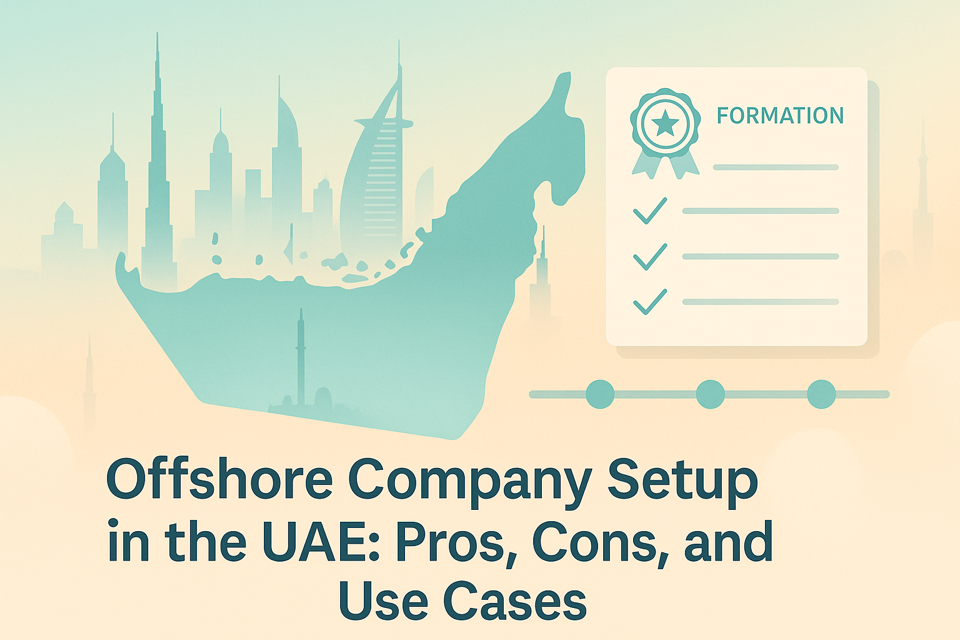
When most people think of setting up a company in the UAE, they think of mainland LLCs or free zone entities. But there is a third structure that is less visible yet widely used by sophisticated investors and international business owners: the UAE offshore company.
Often misunderstood — and sometimes confused with free zone companies — UAE offshore entities serve specific, legitimate purposes in international tax planning, asset protection, and corporate structuring. This guide explains what they are, where they can be set up, what they can and cannot do, and who they are genuinely useful for.
What is a UAE Offshore Company?
A UAE offshore company is a legal entity incorporated in a designated UAE jurisdiction under specific offshore company regulations. Crucially:
- It cannot conduct business activities within the UAE.
- It cannot hire employees or obtain employment visas through the offshore company itself.
- It does not receive a UAE trade licence to operate commercially in the local market.
- It can hold assets, own shares in other companies, hold intellectual property, maintain bank accounts, and conduct business entirely outside the UAE.
UAE Offshore Jurisdictions
There are two primary UAE offshore jurisdictions:
1. RAK International Corporate Centre (RAK ICC)
Based in Ras Al Khaimah, RAK ICC is the UAE’s most widely used offshore jurisdiction and one of the fastest-growing in the world. It operates under the RAK ICC Business Companies Regulations 2018 and offers a modern, flexible corporate framework.
Key features of RAK ICC:
- Fast, straightforward online incorporation (often within 24–48 hours).
- No minimum share capital requirement.
- Flexible share structures, including different classes of shares.
- No requirement to maintain accounts or file financial statements with the authority.
- No requirement for a physical office.
- Directors and shareholders can be of any nationality.
- Can hold real estate in UAE freehold areas (subject to property authority approvals).
2. Jebel Ali Offshore (JAFZA Offshore)
Administered by the Jebel Ali Free Zone Authority (JAFZA) in Dubai, this is an older and more established offshore jurisdiction, particularly popular for businesses that need a Dubai-linked structure or intend to own property in Dubai.
Key features of JAFZA Offshore:
- Can own real estate in Dubai (including properties in Jebel Ali Free Zone).
- Recognised by UAE banks and government entities given its Dubai jurisdiction.
- Slightly more complex and expensive to maintain than RAK ICC.
- Requires a registered agent.
Legitimate Use Cases for UAE Offshore Companies
UAE offshore companies are not tax evasion vehicles — they are legitimate corporate structures with specific, well-recognised applications:
1. International Holding Structure
Perhaps the most common use. An investor or entrepreneur uses a UAE offshore company to hold shares in other companies globally. This creates a clean, low-cost holding layer that can be used to receive dividends, manage group cash flows, and facilitate investment across multiple jurisdictions.
2. Asset Protection
High-net-worth individuals use offshore companies to hold assets — including real estate, investment portfolios, boats, and intellectual property — in a structured, legally distinct entity separate from their personal name. This provides a degree of protection against personal creditor claims.
3. Intellectual Property (IP) Holding
Businesses centralise ownership of trademarks, patents, software, and other IP in a UAE offshore entity, which then licenses the IP to operating companies in other jurisdictions. Given the UAE’s growing network of Double Tax Avoidance Agreements and its 9% Corporate Tax rate, this can be a tax-efficient structure when implemented correctly and at arm’s length.
4. International Trading Structure
An offshore company can act as a trading intermediary between suppliers in one country and customers in another, provided neither transaction involves the UAE domestic market. The offshore entity buys goods from a manufacturer and sells to an overseas buyer — the physical goods never enter the UAE.
5. Estate Planning
Offshore companies can form part of a broader estate planning structure, with shares in the company held through a trust or foundation, allowing for smooth, private succession of assets without the need for probate in multiple jurisdictions.
What a UAE Offshore Company Cannot Do
It is critical to understand the limitations:
- Cannot trade locally: No goods or services can be sold within the UAE market through the offshore entity.
- Cannot obtain a UAE trade licence for mainland or free zone commercial activities.
- Cannot sponsor employees or obtain UAE work/residence visas directly (though the shareholder may be eligible for a visa through other means).
- Cannot open a corporate bank account easily: UAE banks have become increasingly stringent in opening accounts for offshore entities. While possible, it requires the right banking relationships and thorough KYC documentation.
UAE Offshore Companies and Corporate Tax
With the introduction of UAE Corporate Tax from June 2023, the tax treatment of offshore companies has evolved:
- A UAE offshore company that is incorporated in the UAE is generally treated as a Resident Person for Corporate Tax purposes, making it subject to 9% Corporate Tax on any taxable income it generates.
- However, if the offshore company’s activities are structured correctly (e.g., holding exempt Participating Interests, generating qualifying dividends), its effective tax rate may remain at or near 0%.
- Offshore companies used purely as passive holding structures with no active income may have minimal Corporate Tax exposure, but they still have a registration and filing obligation.
Professional tax advice is essential to ensure any offshore structure is UAE Corporate Tax compliant.
Cost of Setting Up a UAE Offshore Company
Costs vary between RAK ICC and JAFZA Offshore, but broadly:
- RAK ICC: Incorporation fees typically range from USD 1,500 to USD 3,000, including registered agent fees. Annual renewal costs are lower than free zone or mainland entities.
- JAFZA Offshore: Generally slightly more expensive than RAK ICC, reflecting the Dubai brand premium.
No annual audit is required for most offshore companies (though good record-keeping remains essential for Corporate Tax purposes).
Is an Offshore Company Right for You?
An offshore company is worth considering if you:
- Need a holding vehicle for international investments or group companies.
- Want to hold real estate in a structured, private way.
- Have legitimate IP that would benefit from centralised ownership.
- Are engaged in international trade between non-UAE parties.
- Want a simple, low-cost corporate vehicle with UAE roots.
It is not appropriate if your primary goal is to do business within the UAE — for that, you need a mainland or free zone entity.
How Success Business Advisors Can Help
Setting up a UAE offshore company correctly requires careful thought about structure, banking, and tax implications. At Success Business Advisors, we provide:
- Jurisdiction selection advice (RAK ICC vs JAFZA Offshore).
- Incorporation and registered agent services.
- Corporate Tax analysis of your proposed offshore structure.
- Banking referrals and KYC package preparation.
- Annual maintenance including renewal and compliance filing.
Contact Success Business Advisors to explore whether a UAE offshore company fits your international business and personal financial goals.
Ready to take the next step?
Schedule an Appointment WHO WE WORK WITH